Home  /  Main contractors

For main contractors

A subcontractor that protects your programme.

Tier 1 contractors work with Trent because the floor goes in when we said it would, to the grade the specification demands, with the paperwork done properly.

The work

Built to make your job easier

When you put a flooring or screed project out to tender, you are buying certainty as much as concrete. A floor that slips, fails its grade or causes a clash costs you far more than the project is worth.

Trent is set up to remove that risk, with self-delivery, honest programming and method built around the realities of your site. Project values run from around £15,000 to £2m and beyond, and we work nationwide from our offices in Burton upon Trent and Aldermaston.

Proof, not promises.

On site

The floor goes in when we said it would.

A completed floor delivered by Trent at the John Radcliffe Hospital.

The tender

What you are actually buying

Three people usually look at our tender, and each of you is asking a different question. Here are the answers.

If you are the estimator

The price is complete

Our price includes the placing, because we run our own line pumps and track-mounted placing booms, so pumping is inside the number rather than a provisional sum that appears later. It includes the flatness or surface regularity survey against the specified grade, the RAMS and the handover documentation. What it does not include is a hopeful programme: if the durations in the tender documents do not work, we tell you at tender and price the duration that does.

If you are the quantity surveyor

Where the variations come from

The two places flooring projects generate variations are the base and the specification. A sub-base or a deck outside tolerance costs concrete volume or a regulating operation, and a flatness grade wrong for the racking or the floor covering costs a remedial. We flag both at tender, in writing. We will also tell you when the specification is tighter than the use requires, because an over-specified flatness grade is money spent for no operational benefit.

If you are the contracts manager

The programme holds

We self-deliver, so there is no second-tier subcontractor to chase and no gap between the crew who places the concrete and the crew who finishes it. We programme backwards from the finishing window, because on a concrete floor the finish is the constraint, and we report honestly, including when it is bad news. If we cannot hit something, you hear it early, not late.

Delivery

Constraints we are built around

Most flooring subcontractors are set up for an empty building. We are set up for the other kind.

  • Live sites. Buildings that keep operating while the floor goes in. Phasing, agreed access windows, agreed routes, noise and dust control, and a method statement written around your operation.
  • Restricted access. Tight gates, low headroom, live yards, limited set-up space, upper floors. Reach is planned into the works.
  • Occupied buildings. Hospitals, schools and operational facilities where the working day belongs to somebody else. We delivered flowing screed inside an operational hospital at the John Radcliffe, around live clinical activity.
  • Secure and regulated sites. Vetting, documentation and protocol-controlled environments. We describe this work by method only and never publish clients or facilities. See secure and regulated environments.
  • Phased programmes. Floors delivered in sections around other trades, with joints and pour sequence designed to suit the phasing.
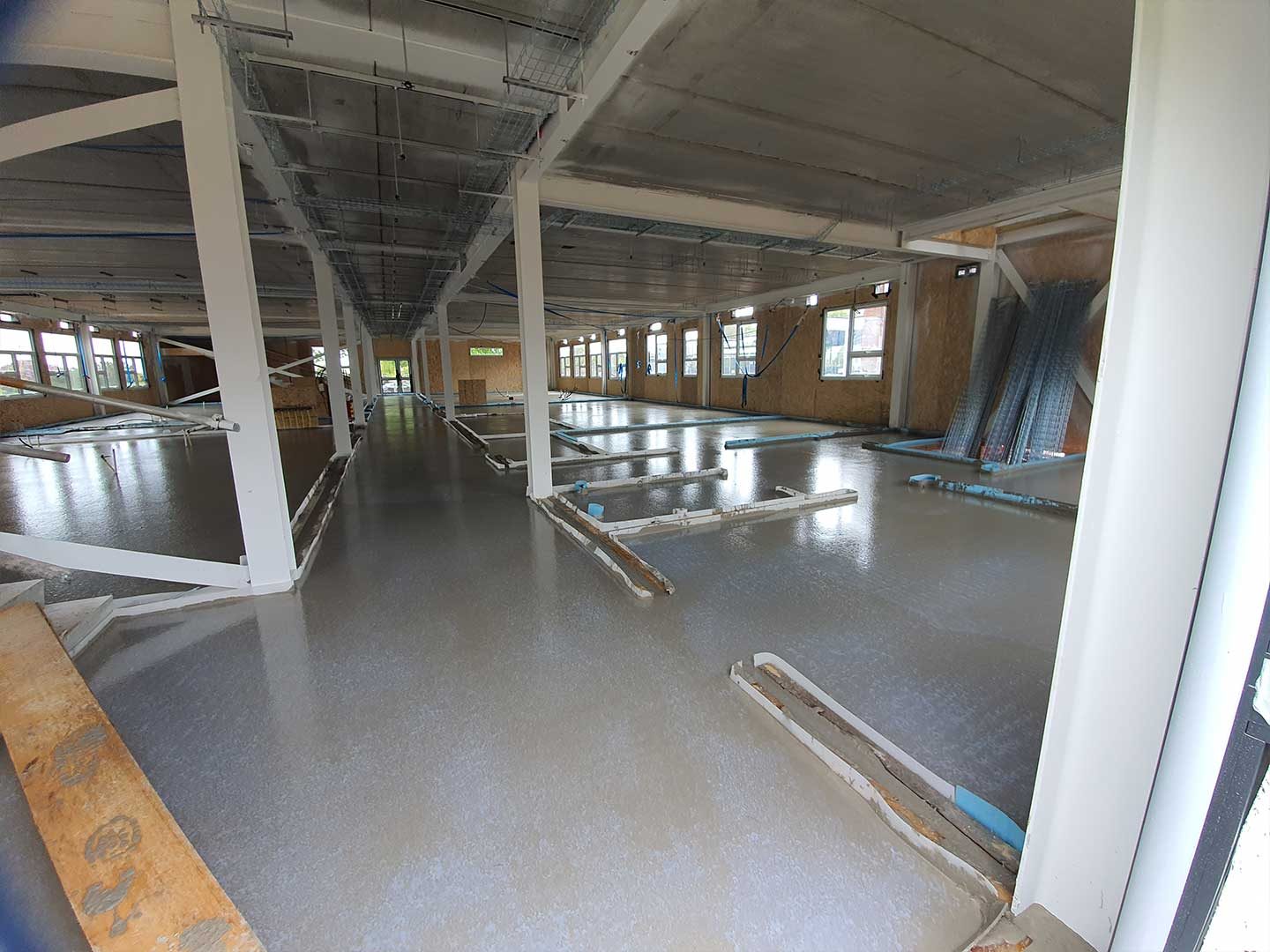
Freshly pumped flowing screed placed by Trent across a floor plate under construction

Capability

Self-delivery, and why it matters here

Our own operatives, our own plant, our own placing booms, start to finish.

On a power floated floor the finish is decided in a two hour window by the people standing on the slab, judging the concrete. A finishing gang who have never worked with the placing gang will guess at that. Ours will not. That is the whole argument for self-delivery, and it is the reason the tolerance holds rather than nearly holds.

The same applies to placing. When the pump is somebody else's, the pour waits on somebody else's day. When it is ours, the placing method is designed into the works from the start.

40
Years in the industry
2hrs
The window in which a power floated finish is decided
£15k–£2m+
Project values, delivered nationwide

Plant most subcontractors do not have

  • Track-mounted placing booms. Rare kit in this country. They reach upper decks and restricted spaces that other plant cannot get to, without craning equipment up.
  • Somero S22EZ laser screed. Laser-guided placing and levelling for large, very flat floors laid at pace.
  • Our own concrete line pumps. So placing is planned as part of the works, not bolted on.

That combination is why we end up on the projects other subcontractors decline. We take on the floors others won't. More on the company and the plant at about Trent.

Standards

Specified grades, evidenced

Flatness is the thing most likely to be argued about at handover, so we settle it with evidence.

In-situ concrete floors are surveyed against the TR34 free movement classification specified, measured on Property E for levelness and Property F for flatness, assessed on the 95th percentile. Screeds are surveyed against the BS 8204 surface regularity class specified.

You get the survey results, the cube results, the pour records and the joint layout as constructed. Not an assurance that it went well.

Proof

Documentation and accreditation

Constructionline Gold registered. ISO 9001 certified. ACIFC member. Avetta and SSIP accredited. Member of the Nuclear Industry Association. We deliver for Tier 1 contractors and major clients including VINCI, McLaren, Costain, Kier, Interclass, Tomlinson, SMD, Actavo, Tarmac and Veolia.

  • RAMS issued and agreed before mobilisation, written around live-site constraints rather than copied
  • Flatness or surface regularity survey against the specified grade
  • Concrete cube results
  • Pour records: date, bay, area, volume, mix and conditions
  • Joint layout as constructed
  • Curing method and durations
  • Sign-off pack at handover

FAQs

Common questions

Do you self-deliver or subcontract?
We self-deliver. Own operatives, own plant, own placing booms, start to finish. There is no second-tier subcontractor in the chain.
Is pumping included in your price?
Yes. We run our own line pumps and placing booms, so placing sits inside the number rather than arriving later as a variation.
What project values do you work at?
Roughly £15,000 up to £2m and beyond, from a single pour to a phased national programme.
Where do you work?
Nationwide. Head office at Trent House, Burton upon Trent, with a southern office at Calleva Park, Aldermaston in Berkshire.
Can you work on live and occupied sites?
Yes, and it is our specialism rather than an exception. Live, restricted-access, occupied and phased work is what we are set up for.
What documentation do we get?
RAMS before mobilisation, then the survey results, cube results, pour records, joint layout as constructed and a sign-off pack at handover.

Got a flooring or screed project coming up?

Send us the drawings and the specification, and we'll tell you straight whether we can deliver it, and how.

Discuss your project