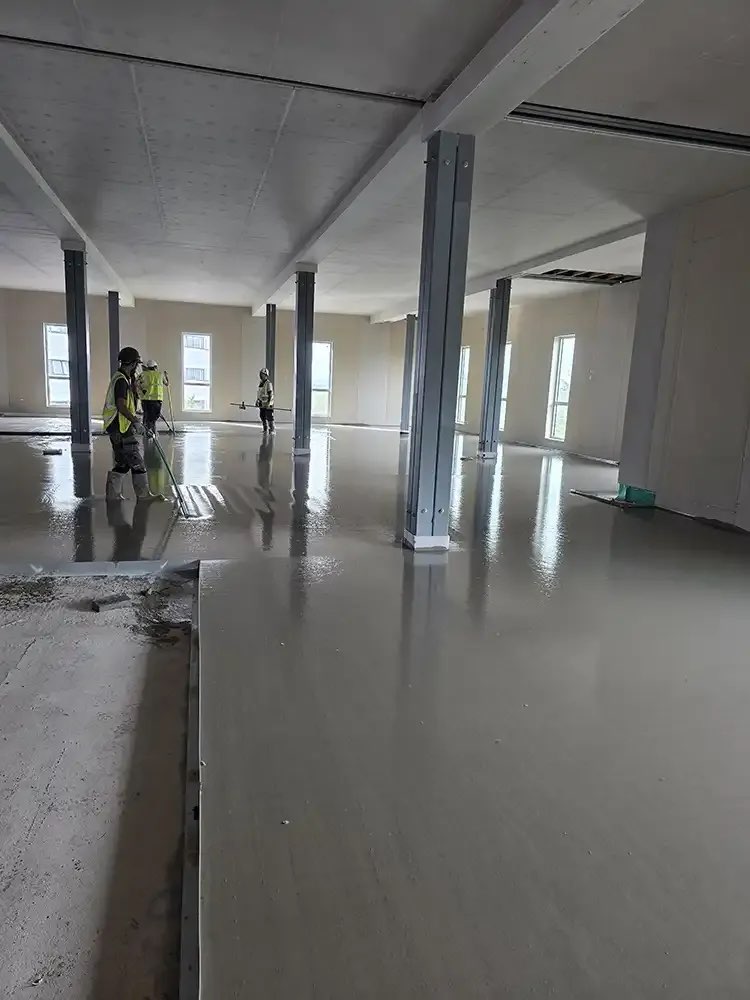
The work
Education projects often mean working in or around occupied buildings, with hard programme constraints set by term dates and exams. The date is not negotiable, and everyone in the chain knows it.
We plan works into holidays and out-of-hours windows where needed, using fast, low-disruption methods. Our own crews, our own pumps and our own placing booms, so the programme does not depend on somebody else's plant turning up.
Proof, not promises. On an education project the promise that matters is the handover date, and it is made at tender.
On most sectors the specification drives the programme. Here it is the other way round.
A summer holiday is roughly six weeks. Into that window go strip-out, structural work, mechanical and electrical first fix, floors, second fix, decoration, furniture and a deep clean, on a site that must be fully operational and signed off before pupils return. The floor sits in the middle of that chain, and every day it slips comes off the end of somebody else's trade.
That produces three consequences worth pricing honestly.
Holiday window or term-time phasing? A single summer programme and a phased term-time programme are different jobs with different prices. Decide before pricing.
What is the floor covering, and when does it need the base? The covering manufacturer's moisture requirement sets the drying period, and the drying period sets whether the programme is achievable at all.
Which screed system does the site permit? If evening working is out because of safeguarding or caretaking arrangements, self-compacting removes the power floating step that forces it.
Is the building occupied during the works? Safeguarding, separation, agreed routes, DBS requirements and hoarding all follow from this and all affect the price.
Is it a screed or a slab? New-build teaching blocks, sports halls and plant areas include structural slabs. Refurbishment is usually screed. Many projects are both.
Sports hall or specialist floor? Sports halls, workshops, science laboratories and kitchens each have their own substrate requirements and should be priced separately rather than averaged.
Flowing screed, also called liquid screed, pumped and self-levelling. Fast coverage over large teaching floor areas and the best method where underfloor heating is specified.
Self-compacting screed where evening and night working is not permitted, which on a school site is common.
Screeds on precast planks for upper floors in multi-storey teaching blocks and student accommodation, which are frequently built on precast frames. Our placing booms reach the decks without craning plant up.
In-situ concrete slabs for sports halls, plant rooms and new-build teaching blocks, plus concrete hardstanding for car parks, service yards and hard play areas.
Speed and containment, for the same reasons they suit healthcare.
A pumped screed arrives through a hose rather than a barrow run down a corridor. A large teaching floor plate goes down in a single visit, and the crew leaves the same day. In a six-week window, removing days from the laying operation is worth more than saving a few pounds per square metre.
Self-compacting systems remove the power floating step entirely, which means no crew returning to the building in the evening. On a school with caretaking hours, safeguarding requirements and no appetite for contractors on site after dark, that is often the deciding factor rather than a preference.
Constructionline Gold registered. Avetta and SSIP accredited. Member of the Nuclear Industry Association.
On site
We plan the method, phasing and plant so work continues around us and the floor goes down right first time.
FAQs
Send us the drawings and the specification, and we'll tell you straight whether we can deliver it, and how.
Discuss your project