---
title: Commercial Flowing Screed Contractor | Liquid Screed | Trent
description: Commercial flowing (liquid) screed, pumped and laid by our own crews on live sites, hospitals, schools and precast decks. Main contractors only, not domestic.
image: https://www.trentcs.com/hubfs/OG%20images/og-screeds-flowing-screed.png
---
- Services
[Concrete flooring](https://www.trentcs.com/concrete-flooring)
- [Power floated floors](https://www.trentcs.com/concrete-flooring/power-floated)
- [Hardstandings](https://www.trentcs.com/concrete-flooring/hardstanding)
- [Large pours](https://www.trentcs.com/concrete-flooring/large-pour)
[Screeds](https://www.trentcs.com/screeds)
- [Flowing screed](https://www.trentcs.com/screeds/flowing-screed)
- [Self-compacting](https://www.trentcs.com/screeds/self-compacting)
- [Precast plank](https://www.trentcs.com/screeds/precast-plank)
- [Concrete pumping](https://www.trentcs.com/concrete-pumping)
- Sectors
- [All sectors](https://www.trentcs.com/sectors)
- [Healthcare](https://www.trentcs.com/sectors/healthcare)
- [Data centres](https://www.trentcs.com/sectors/data-centres)
- [Industrial & logistics](https://www.trentcs.com/sectors/industrial-logistics)
- [Education](https://www.trentcs.com/sectors/education)
- [Waste & energy](https://www.trentcs.com/sectors/waste-energy)
- [Secure & regulated](https://www.trentcs.com/sectors/secure-regulated)
- [Projects](https://www.trentcs.com/projects)
- [Knowledge](https://www.trentcs.com/knowledge)
- [About](https://www.trentcs.com/about)
- [Main contractors](https://www.trentcs.com/main-contractors)
- [01283 480110](tel:01283480110)
- [Discuss your project](https://www.trentcs.com/contact)
[01283 480110](tel:01283480110)
☰
- Services
[Concrete flooring](https://www.trentcs.com/concrete-flooring)
- [Power floated floors](https://www.trentcs.com/concrete-flooring/power-floated)
- [Hardstandings](https://www.trentcs.com/concrete-flooring/hardstanding)
- [Large pours](https://www.trentcs.com/concrete-flooring/large-pour)
[Screeds](https://www.trentcs.com/screeds)
- [Flowing screed](https://www.trentcs.com/screeds/flowing-screed)
- [Self-compacting](https://www.trentcs.com/screeds/self-compacting)
- [Precast plank](https://www.trentcs.com/screeds/precast-plank)
- [Concrete pumping](https://www.trentcs.com/concrete-pumping)
- Sectors
- [All sectors](https://www.trentcs.com/sectors)
- [Healthcare](https://www.trentcs.com/sectors/healthcare)
- [Data centres](https://www.trentcs.com/sectors/data-centres)
- [Industrial & logistics](https://www.trentcs.com/sectors/industrial-logistics)
- [Education](https://www.trentcs.com/sectors/education)
- [Waste & energy](https://www.trentcs.com/sectors/waste-energy)
- [Secure & regulated](https://www.trentcs.com/sectors/secure-regulated)
- [Projects](https://www.trentcs.com/projects)
- [Knowledge](https://www.trentcs.com/knowledge)
- [About](https://www.trentcs.com/about)
- [Main contractors](https://www.trentcs.com/main-contractors)
- [Call 01283 480110](tel:01283480110)
- [Discuss your project](https://www.trentcs.com/contact)
[Home](https://www.trentcs.com/) / [Screeds](https://www.trentcs.com/screeds) / Flowing screed
Screeds
# Commercial flowing *screed.*
Trent Construction Services installs pumped flowing screed, also known as liquid screed, for main contractors on commercial projects across the UK. It self-levels for fast, flat floors over large areas, ideal for underfloor heating and tight programmes.
Who it's for
Main contractors and clients on commercial projects. We don't take on domestic or self-build work.
Project size
Around £15,000 to £2m and beyond
Standards
Surface regularity to BS 8204 (SR1, SR2 or SR3 as specified). Screed materials to BS EN 13813.
Systems
Cementitious flowing screeds, including Cemfloor and Longfloor, and calcium sulphate (anhydrite) screeds. We generally recommend cementitious.
Typical output and depth
300 to 1,000m² a day. Screeds are typically around 40 to 100mm deep.
Drying
Light foot traffic the next day. Full loading after 7 to 28 days, depending on the screed. Floor coverings once the screed passes its moisture test.
Plant and people
Our own operatives and plant, including concrete line pumps and track-mounted placing booms
Accreditations
Constructionline Gold, ISO 9001, ACIFC member, Cyber Essentials Plus, Avetta, SSIP, Nuclear Industry Association
Offices
Burton on Trent (head office) and Aldermaston, Berkshire. Working nationwide.
The work
## Pumped, level and ready to programme
Flowing screed arrives as a liquid, is pumped into place and levels itself. There is no laying to rails, no tamping and no hand finishing across the bulk of the area. That produces a flat, dense floor far quicker than traditional sand and cement, with excellent coverage around underfloor heating pipes.
We work on commercial projects for main contractors and clients: industrial, healthcare, education, energy and infrastructure. We don't take on domestic or self-build screeds. For a house, a local domestic screed installer will serve you better.
You will see the same product called liquid screed, flow screed, self-levelling screed or self-compacting screed depending on who is writing the specification. They describe the same method: a pumped, free-flowing screed that consolidates under its own weight.
Speed and cleanliness are the reasons it wins. A crew, a pump and a hose replace a barrow run and a floor full of labourers, which is what makes it viable in live and occupied buildings where a traditional screed simply cannot be programmed.
On site
## Fast, flat and clean, *even mid-programme.*
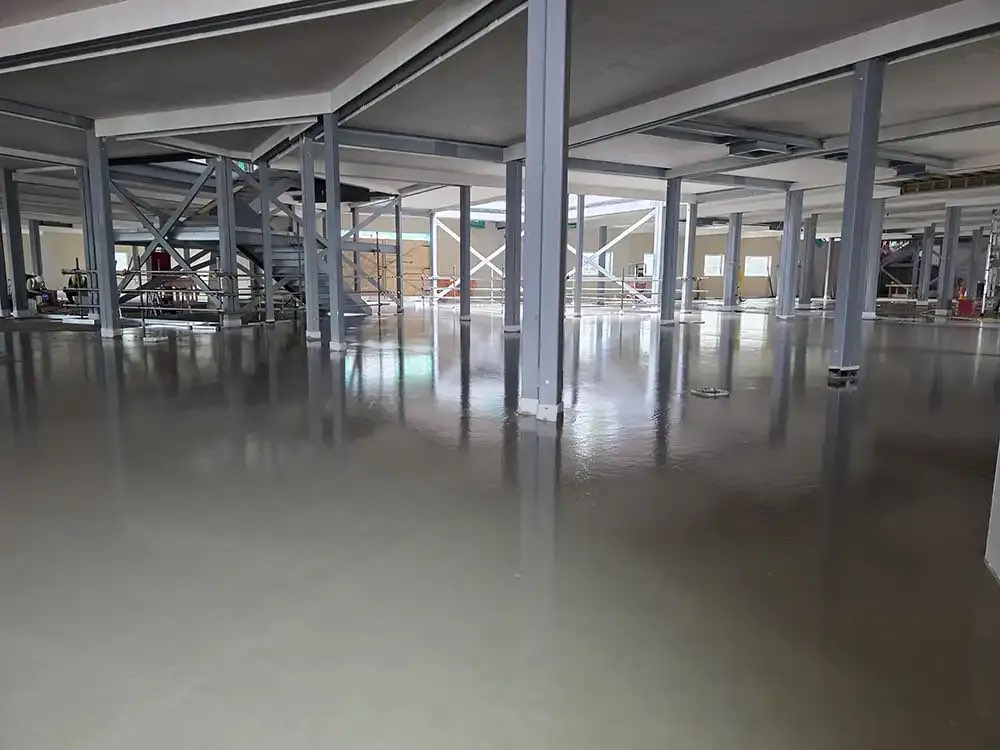
A Trent crew levelling pumped flowing screed across an occupied-building floor plate.
The comparison
## Liquid screed versus traditional sand and cement
This is the comparison most estimators are actually running, so here it is straight. For the wider choice between flowing, self-compacting and traditional systems, see [screeds](https://www.trentcs.com/screeds).
### Speed
Liquid screed covers a large area in a single visit. Traditional screed is laid by hand in bays and takes considerably longer over the same floor plate.
### Depth
Liquid screed can be laid thinner than traditional screed for the same performance, particularly over underfloor heating. Less depth means less weight on the structure and less material.
### Underfloor heating
Liquid screed flows around and fully encases the pipes, so there are no voids against the pipe. Full contact means better heat transfer and a more responsive, more efficient system.
### Flatness
Self-levelling gives a consistently flat surface across large areas without a skilled hand finish on every square metre.
### Drying
The trade-off. Some liquid screeds dry no faster than traditional screed unless force-dried, and moisture content has to be right before coverings go down. Drying is a programme item to be designed in, not a benefit to be assumed.
### Cost per square metre
Material is usually dearer, labour and programme usually cheaper. On a large floor plate liquid screed generally wins. On a small, constrained, chopped-up area it often does not.
Scoping
## The decision you are actually making
Four questions set the price and the programme. Answer them at tender and the job runs clean.
- **Which binder?** Liquid screeds are broadly either calcium sulphate based (also called anhydrite) or cementitious. Calcium sulphate screeds flow well and are widely used, but they are moisture-sensitive, form a surface laitance that usually has to be removed before adhered coverings, and are not suitable in permanently wet areas. Cementitious flowing screeds avoid both and cost more. The floor covering and the room use should decide this, not the price.
- **Bonded, unbonded or floating?** Bonded goes directly onto a prepared base, unbonded sits on a membrane, floating sits on insulation, the normal arrangement over underfloor heating. Each has a different minimum depth and a different consequence if the base is out of tolerance.
- **What is the base doing?** Screed follows the base. If the deck is out of level you either add depth, which adds weight and cost, or you regulate first. Confirm the deck survey before the screed is priced, not after.
- **What is going on top, and when?** Moisture-sensitive coverings drive the drying programme, and the drying programme often drives the whole fit-out. If a vinyl or resin finish is following, the screed date and the covering date are linked and both need to be real.
Applications
## Where liquid screed earns its place
### [Sector Healthcare Hospitals cannot stop. Pumped liquid screed goes down fast, in a clean, contained method, phased around clinical activity. We have delivered flowing screed in an operational hospital. Read more](https://www.trentcs.com/sectors/healthcare)
### [Sector Education estates Term dates and exams set hard programme constraints. A pumped screed fits a holiday window in a way a traditional screed does not. Read more](https://www.trentcs.com/sectors/education)
### [Service Upper decks & precast planks Hollowcore decks need a screed that levels fast and reaches every part of the deck. Our placing booms deliver screed across upper floors without craning plant up. Read more](https://www.trentcs.com/screeds/precast-plank)
Application
### Large floor plates
Where coverage and flatness both matter over a big area, liquid screed delivers both quickly, and its cost advantage is clearest.
Application
### Underfloor heating
Full pipe encasement, thinner cover, faster response, better efficiency. The commissioning and heat-up regime has to be planned in, following the manufacturer's heat-up profile.
Standards
## Tolerances and standards
Screed surface regularity in the UK is normally specified to BS 8204, which sets three classes measured as the maximum deviation under a 2m straightedge:
| Class | Maximum deviation | Typically used for |
| --- | --- | --- |
| SR1 | 3mm | High specification floors and demanding floor finishes |
| SR2 | 5mm | The general default for most commercial projects |
| SR3 | 10mm | Utility areas and floors taking a thick applied finish |
Screed materials themselves are classified by binder type under BS EN 13813, which is what the manufacturer's declaration of performance refers to. We survey the finished screed against the class specified and issue the results.
Capability
## Plant and crews, self-delivered
Our own operatives, our own pumps, our own placing booms, start to finish. None of the flowing screed work is subcontracted.
Placing is the part that catches people out. A liquid screed is only as good as the pour that delivers it, and on constrained sites getting the material to the deck is the whole job. We run our own concrete line pumps and track-mounted placing booms, rare kit in this country. That reach is why we can screed upper decks, restricted spaces and buildings that are still in use, on projects other subcontractors decline.
Because the placing plant is ours, the method is planned as part of the works rather than bolted on. Pump positions, hose runs, boom set-up and wash-out are agreed before we mobilise.
Programme
## Output, programme and constraints
Pumped screed covers ground quickly. The constraint is rarely the screed itself, it is access, delivery, pump set-ups and how much of the deck is genuinely ready. We programme from the ready date backwards.
- **Live and occupied buildings.** The reason most clients call us rather than a general screeder. Phasing is agreed around the building's use, not around our convenience.
- **Method designed up front.** Access windows, out-of-hours working, delivery routes, lift and door restrictions, noise limits and dust control all go into the method statement before we arrive.
- **Restricted access handled with plant.** Where a pump cannot reach, the boom can. Where neither can, we will tell you at tender rather than find out on the day.
- **Honesty about readiness.** If the deck preparation, insulation, UFH installation or edge detailing will not be complete when the programme says, we say so before the pump is booked. That conversation is cheaper early.
Proof
## Evidence and documentation
- Surface regularity survey against the specified BS 8204 class
- Delivery tickets and batch records for the screed supplied
- Pour records covering area, depth, date and conditions
- Manufacturer's declaration of performance for the system installed
- Moisture readings prior to floor coverings where we are asked to take them
- RAMS issued and agreed before mobilisation
- Sign-off pack at handover
Constructionline Gold registered. ISO 9001 certified. ACIFC member. Cyber Essentials Plus, Avetta and SSIP accredited. Member of the Nuclear Industry Association.
FAQs
## Common questions
Is flowing screed the same as liquid screed?
Yes. Flowing screed, liquid screed, flow screed and self-levelling screed all describe a pumped screed that consolidates under its own weight. Specifications use the terms interchangeably.
Is flowing screed suitable for underfloor heating?
Yes, and it is the best method for it. It flows around and fully encases the pipes for complete contact, better heat transfer and a more efficient system, and it can be laid at less depth over the pipes than a traditional screed.
How disruptive is it to an occupied building?
Low. It is pumped, fast and contained, so it suits live and occupied environments with careful phasing. That is the main reason it is used in hospitals and schools.
How long before we can walk on it, and before floor coverings go down?
Typically light foot traffic the next day, and full loading after 7 to 28 days, depending on the screed. Floor coverings go down once the screed passes its moisture test. Drying depends on depth, conditions and ventilation, so we plan it into the programme rather than promise a date.
Do you offer rapid-drying or force-dried screed?
We don't promise it. We'd rather agree a realistic drying period at tender than commit to an accelerated one.
How much can you lay in a day?
Typically 300 to 1,000m² a day, depending on supply, depth and the complexity of the job. Screeds are typically around 40 to 100mm deep.
Calcium sulphate or cementitious, which should I specify?
Let the room and the floor covering decide. Calcium sulphate is widely used and flows well, but it is moisture-sensitive and usually needs its laitance removing before adhered coverings. Cementitious avoids both issues and costs more. Send us the finishes schedule and we will advise. We install both, including Cemfloor and Longfloor, and generally recommend cementitious.
Can it be laid on a precast plank deck?
Yes, and it is a strong fit. Our placing booms deliver screed across upper decks without craning plant up.
Do you lay liquid screed for houses or self-builds?
No. We work on commercial projects only, for main contractors and clients. For a domestic screed, a local installer will be quicker and better value.
Related
[Sector**Healthcare***→*](https://www.trentcs.com/sectors/healthcare)[Project**John Radcliffe Hospital***→*](https://www.trentcs.com/knowledge/flowing-screed-at-john-radcliffe-hospital)[Service**Self-compacting screed***→*](https://www.trentcs.com/screeds/self-compacting)
Guides and case studies
[Guide**Floor screeds for schools: making the holiday window work***→*](https://www.trentcs.com/knowledge/floor-screeds-for-schools-making-the-holiday-window-work)
## Got a flooring or screed *project coming up?*
Send us the drawings and the specification, and we'll tell you straight whether we can deliver it, and how.
[Discuss your project](https://www.trentcs.com/contact)
Specialist concrete flooring and screed subcontractor. Our own teams and plant, finished to specification. Nationwide.
 Certificate No. 292582018
Services
- [Concrete flooring](https://www.trentcs.com/concrete-flooring)
- [Screeds](https://www.trentcs.com/screeds)
- [Concrete pumping](https://www.trentcs.com/concrete-pumping)
- [Projects](https://www.trentcs.com/projects)
Company
- [About](https://www.trentcs.com/about)
- [Sectors](https://www.trentcs.com/sectors)
- [Main contractors](https://www.trentcs.com/main-contractors)
- [Knowledge](https://www.trentcs.com/knowledge)
- [Contact](https://www.trentcs.com/contact)
Contact
- **Head office**
Trent House, Bridge Park,
Wetmore Road, Burton on Trent,
DE14 1PW
- **Aldermaston**
Suite 1 Calleva Business Centre,
Calleva Park, Aldermaston,
Berkshire, RG7 8UA
- [01283 480110](tel:01283480110)
- [info@trentcs.com](mailto:info@trentcs.com)
© 2026 Trent Construction Services Ltd. All rights reserved. [Privacy](https://www.trentcs.com/legal#privacy) · [Cookies](https://www.trentcs.com/legal#cookies) · [Terms](https://www.trentcs.com/legal#terms) ·
Cookie settings
Laid to last.
```json
{
"@context" : "https://schema.org",
"@type" : "FAQPage",
"mainEntity" : [ {
"@type" : "Question",
"acceptedAnswer" : {
"@type" : "Answer",
"text" : "Yes. Flowing screed, liquid screed, flow screed and self-levelling screed all describe a pumped screed that consolidates under its own weight. Specifications use the terms interchangeably."
},
"name" : "Is flowing screed the same as liquid screed?"
}, {
"@type" : "Question",
"acceptedAnswer" : {
"@type" : "Answer",
"text" : "Yes, and it is the best method for it. It flows around and fully encases the pipes for complete contact, better heat transfer and a more efficient system, and it can be laid at less depth over the pipes than a traditional screed."
},
"name" : "Is flowing screed suitable for underfloor heating?"
}, {
"@type" : "Question",
"acceptedAnswer" : {
"@type" : "Answer",
"text" : "Low. It is pumped, fast and contained, so it suits live and occupied environments with careful phasing. That is the main reason it is used in hospitals and schools."
},
"name" : "How disruptive is it to an occupied building?"
}, {
"@type" : "Question",
"acceptedAnswer" : {
"@type" : "Answer",
"text" : "Typically light foot traffic the next day, and full loading after 7 to 28 days, depending on the screed. Floor coverings go down once the screed passes its moisture test. Drying depends on depth, conditions and ventilation, so we plan it into the programme rather than promise a date."
},
"name" : "How long before we can walk on it, and before floor coverings go down?"
}, {
"@type" : "Question",
"acceptedAnswer" : {
"@type" : "Answer",
"text" : "We don't promise it. We'd rather agree a realistic drying period at tender than commit to an accelerated one."
},
"name" : "Do you offer rapid-drying or force-dried screed?"
}, {
"@type" : "Question",
"acceptedAnswer" : {
"@type" : "Answer",
"text" : "Typically 300 to 1,000m² a day, depending on supply, depth and the complexity of the job. Screeds are typically around 40 to 100mm deep."
},
"name" : "How much can you lay in a day?"
}, {
"@type" : "Question",
"acceptedAnswer" : {
"@type" : "Answer",
"text" : "Let the room and the floor covering decide. Calcium sulphate is widely used and flows well, but it is moisture-sensitive and usually needs its laitance removing before adhered coverings. Cementitious avoids both issues and costs more. Send us the finishes schedule and we will advise. We install both, including Cemfloor and Longfloor, and generally recommend cementitious."
},
"name" : "Calcium sulphate or cementitious, which should I specify?"
}, {
"@type" : "Question",
"acceptedAnswer" : {
"@type" : "Answer",
"text" : "Yes, and it is a strong fit. Our placing booms deliver screed across upper decks without craning plant up."
},
"name" : "Can it be laid on a precast plank deck?"
}, {
"@type" : "Question",
"acceptedAnswer" : {
"@type" : "Answer",
"text" : "No. We work on commercial projects only, for main contractors and clients. For a domestic screed, a local installer will be quicker and better value."
},
"name" : "Do you lay liquid screed for houses or self-builds?"
} ]
}
```
```json
{
"@context" : "https://schema.org",
"@type" : "BreadcrumbList",
"itemListElement" : [ {
"@type" : "ListItem",
"item" : "https://www.trentcs.com/",
"name" : "Home",
"position" : 1
}, {
"@type" : "ListItem",
"item" : "https://www.trentcs.com/screeds",
"name" : "Screeds",
"position" : 2
}, {
"@type" : "ListItem",
"name" : "Flowing screed",
"position" : 3
} ]
}
```
```json
{
"@context" : "https://schema.org",
"@type" : "Service",
"areaServed" : {
"@type" : "Country",
"name" : "United Kingdom"
},
"audience" : {
"@type" : "BusinessAudience",
"audienceType" : "Main contractors and clients on commercial construction projects"
},
"description" : "Trent Construction Services installs pumped flowing screed, also known as liquid screed, for main contractors on commercial projects across the UK. It self-levels for fast, flat floors over large areas, ideal for underfloor heating and tight programmes.",
"name" : "Flowing screed (liquid screed)",
"provider" : {
"@id" : "https://www.trentcs.com/#organization"
},
"serviceType" : "Flowing screed (liquid screed)",
"url" : "https://www.trentcs.com/screeds/flowing-screed"
}
```
```json
{
"@context" : "https://schema.org",
"@id" : "https://www.trentcs.com/#organization",
"@type" : "Organization",
"address" : {
"@type" : "PostalAddress",
"addressCountry" : "GB",
"addressLocality" : "Burton on Trent",
"addressRegion" : "Staffordshire",
"postalCode" : "DE14 1PW",
"streetAddress" : "Trent House, Bridge Park, Wetmore Road"
},
"areaServed" : {
"@type" : "Country",
"name" : "United Kingdom"
},
"audience" : {
"@type" : "BusinessAudience",
"audienceType" : "Main contractors and clients on commercial construction projects"
},
"contactPoint" : {
"@type" : "ContactPoint",
"areaServed" : "GB",
"availableLanguage" : "English",
"contactType" : "sales",
"email" : "info@trentcs.com",
"telephone" : "+441283480110"
},
"description" : "Specialist concrete flooring and screed subcontractor for main contractors and clients on commercial projects across the UK, including live, restricted-access and constrained sites. No domestic or self-build work.",
"email" : "info@trentcs.com",
"foundingDate" : "2012-03-13",
"hasCredential" : [ {
"@type" : "EducationalOccupationalCredential",
"credentialCategory" : "certification",
"name" : "Constructionline Gold"
}, {
"@type" : "EducationalOccupationalCredential",
"credentialCategory" : "certification",
"name" : "Avetta accredited"
}, {
"@type" : "EducationalOccupationalCredential",
"credentialCategory" : "certification",
"name" : "SSIP member"
}, {
"@type" : "EducationalOccupationalCredential",
"credentialCategory" : "certification",
"name" : "ISO 9001"
}, {
"@type" : "EducationalOccupationalCredential",
"credentialCategory" : "certification",
"name" : "Cyber Essentials Plus"
} ],
"identifier" : {
"@type" : "PropertyValue",
"propertyID" : "Companies House company number",
"value" : "07988958"
},
"knowsAbout" : [ "Power floated concrete floors", "Laser screed concrete flooring", "Concrete hardstanding", "Flowing screed", "Self-compacting screed", "Screeds on precast planks", "Concrete pumping and placing booms" ],
"legalName" : "Trent Construction Services Ltd",
"location" : [ {
"@type" : "Place",
"address" : {
"@type" : "PostalAddress",
"addressCountry" : "GB",
"addressLocality" : "Burton on Trent",
"addressRegion" : "Staffordshire",
"postalCode" : "DE14 1PW",
"streetAddress" : "Trent House, Bridge Park, Wetmore Road"
},
"name" : "Head office"
}, {
"@type" : "Place",
"address" : {
"@type" : "PostalAddress",
"addressCountry" : "GB",
"addressLocality" : "Aldermaston",
"addressRegion" : "Berkshire",
"postalCode" : "RG7 8UA",
"streetAddress" : "Suite 1 Calleva Business Centre, Calleva Park"
},
"name" : "Aldermaston office"
} ],
"memberOf" : [ {
"@type" : "Organization",
"alternateName" : "ACIFC",
"name" : "Association of Concrete Industrial Flooring Contractors"
}, {
"@type" : "Organization",
"name" : "Nuclear Industry Association"
} ],
"name" : "Trent Construction Services",
"sameAs" : [ "https://find-and-update.company-information.service.gov.uk/company/07988958" ],
"slogan" : "Laid to last.",
"telephone" : "+441283480110",
"url" : "https://www.trentcs.com/"
}
```
```json
{
"@context" : "https://schema.org",
"@id" : "https://www.trentcs.com/#website",
"@type" : "WebSite",
"description" : "Specialist concrete flooring and screed subcontractor working on live, restricted-access and constrained sites nationwide.",
"inLanguage" : "en-GB",
"name" : "Trent Construction Services",
"publisher" : {
"@id" : "https://www.trentcs.com/#organization"
},
"url" : "https://www.trentcs.com/"
}
```