---
title: Concrete Pumping & Placing Booms | Tight Access | Trent
description: Line pumping and track-mounted placing booms for sites with tight access, height or live constraints. Integrated with our flooring and screeds.
image: https://www.trentcs.com/hubfs/OG%20images/og-concrete-pumping.png
---
- Services
[Concrete flooring](https://www.trentcs.com/concrete-flooring)
- [Power floated floors](https://www.trentcs.com/concrete-flooring/power-floated)
- [Hardstandings](https://www.trentcs.com/concrete-flooring/hardstanding)
- [Large pours](https://www.trentcs.com/concrete-flooring/large-pour)
[Screeds](https://www.trentcs.com/screeds)
- [Flowing screed](https://www.trentcs.com/screeds/flowing-screed)
- [Self-compacting](https://www.trentcs.com/screeds/self-compacting)
- [Precast plank](https://www.trentcs.com/screeds/precast-plank)
- [Concrete pumping](https://www.trentcs.com/concrete-pumping)
- Sectors
- [All sectors](https://www.trentcs.com/sectors)
- [Healthcare](https://www.trentcs.com/sectors/healthcare)
- [Data centres](https://www.trentcs.com/sectors/data-centres)
- [Industrial & logistics](https://www.trentcs.com/sectors/industrial-logistics)
- [Education](https://www.trentcs.com/sectors/education)
- [Waste & energy](https://www.trentcs.com/sectors/waste-energy)
- [Secure & regulated](https://www.trentcs.com/sectors/secure-regulated)
- [Projects](https://www.trentcs.com/projects)
- [Knowledge](https://www.trentcs.com/knowledge)
- [About](https://www.trentcs.com/about)
- [Main contractors](https://www.trentcs.com/main-contractors)
- [01283 480110](tel:01283480110)
- [Discuss your project](https://www.trentcs.com/contact)
[01283 480110](tel:01283480110)
☰
- Services
[Concrete flooring](https://www.trentcs.com/concrete-flooring)
- [Power floated floors](https://www.trentcs.com/concrete-flooring/power-floated)
- [Hardstandings](https://www.trentcs.com/concrete-flooring/hardstanding)
- [Large pours](https://www.trentcs.com/concrete-flooring/large-pour)
[Screeds](https://www.trentcs.com/screeds)
- [Flowing screed](https://www.trentcs.com/screeds/flowing-screed)
- [Self-compacting](https://www.trentcs.com/screeds/self-compacting)
- [Precast plank](https://www.trentcs.com/screeds/precast-plank)
- [Concrete pumping](https://www.trentcs.com/concrete-pumping)
- Sectors
- [All sectors](https://www.trentcs.com/sectors)
- [Healthcare](https://www.trentcs.com/sectors/healthcare)
- [Data centres](https://www.trentcs.com/sectors/data-centres)
- [Industrial & logistics](https://www.trentcs.com/sectors/industrial-logistics)
- [Education](https://www.trentcs.com/sectors/education)
- [Waste & energy](https://www.trentcs.com/sectors/waste-energy)
- [Secure & regulated](https://www.trentcs.com/sectors/secure-regulated)
- [Projects](https://www.trentcs.com/projects)
- [Knowledge](https://www.trentcs.com/knowledge)
- [About](https://www.trentcs.com/about)
- [Main contractors](https://www.trentcs.com/main-contractors)
- [Call 01283 480110](tel:01283480110)
- [Discuss your project](https://www.trentcs.com/contact)
[Home](https://www.trentcs.com/) / Concrete pumping
Capability
# Concrete *pumping.*
Trent Construction Services runs its own concrete line pumps and track-mounted placing booms on its flooring and screed projects across the UK, reaching the places other plant can't on sites with tight access, height or live constraints.
Who it's for
Main contractors and clients on commercial projects. We don't take on domestic or self-build work.
Project size
Around £15,000 to £2m and beyond
Plant and people
Our own operatives and plant, including concrete line pumps and two track-mounted placing booms
Reach and output
Line pumps around 100m vertically and 175m horizontally, rated above 50m³ an hour. Placing booms around 16m vertically.
Accreditations
Constructionline Gold, ISO 9001, ACIFC member, Cyber Essentials Plus, Avetta, SSIP, Nuclear Industry Association
Offices
Burton on Trent (head office) and Aldermaston, Berkshire. Working nationwide.
The work
## Getting concrete where it needs to go
Pumping is often the difference between a job being possible and not. Our line pumps and placing booms move concrete and screed accurately over distance, around obstacles and up to height.
We run our own pumping alongside our flooring and screeding teams, so the placing method is planned as part of the works, not bolted on. That is the whole proposition on this page, and it is worth being clear about why it matters commercially rather than just technically.
When placing is subcontracted, the pour depends on somebody else's day. When it is ours, the pour depends on ours.
On site
## Our own plant, *planned into the works.*
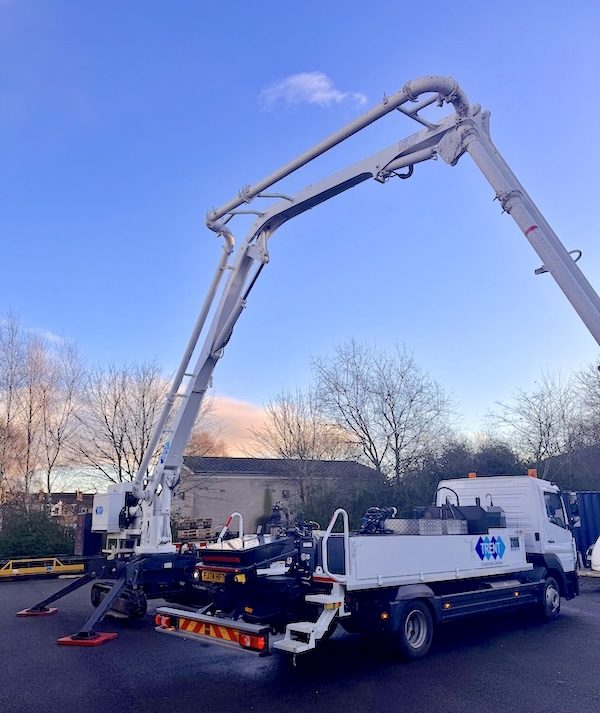
A Trent concrete pumping unit in our plant yard.
The difference
## Why self-delivered placing changes the price
Most flooring and screeding subcontractors hire in a pump. It works fine on an easy site. On a difficult one it produces three problems that end up on your desk. Our price includes the placing, because our plant is doing it, so there is no provisional sum that grows later.
- **The pour waits.** A hired pump arrives when it arrives, and if it is late or breaks down, the concrete is already on the road. On a power floated floor, where the finishing window is fixed by the concrete rather than by the diary, a delayed pour can cost the finish.
- **Nobody owns the method.** A pump operator who turned up this morning has no stake in the pour sequence, the joint layout or the finishing programme. Ours planned it with the flooring crew.
- **Access gets discovered, not designed.** When the pump is hired by the day, reach, set-up footprint and outrigger loadings are assumed rather than surveyed, and turn into a site problem on the morning of the pour.
The plant
## Line pumps and placing booms are not the same thing
The terms get used loosely at tender, so worth separating. We run our own track-mounted placing booms, rare kit in this country, plus our own line pumps. That combination is the reason we take on floors and screeds that other subcontractors decline.
### Line pumps
Push concrete through pipeline laid along the ground and through the building. They go through doorways, around corners, up stairs, over walls and through gaps that no vehicle can reach. Reach is a matter of how much line you run and what the mix will take. The answer to horizontal access problems.
### Placing booms
Articulated arms that place concrete accurately at a point, at height, without a pipeline being hand-laid to get there. Ours are track-mounted, which means they move themselves across a site and set up without a crane. The answer to vertical and constrained access problems.
Scope
## What we pump
Concrete for [in-situ floors](https://www.trentcs.com/concrete-flooring), including ground-bearing slabs, suspended slabs and external hardstandings.
Flowing, liquid and self-compacting [screeds](https://www.trentcs.com/screeds), including onto precast plank and hollowcore decks at height. See [screeds on precast planks](https://www.trentcs.com/screeds/precast-plank).
Placing for our own works is the priority, and it is how the plant earns its keep. Pumping is a capability inside the flooring and screeding offer rather than a separate hire business.
Scoping
## The decision you are actually making
### Can ready-mix reach the pour face?
If it can, direct discharge is cheapest. If it cannot, pumping is not an upgrade, it is the only method.
### Horizontal problem or vertical problem?
Distance through a building is a line pump job. Height and accurate placing at a point is a boom job. Some pours are both.
### What is the set-up space, and what will it carry?
Plant has to stand somewhere, and on a suspended deck or a finished yard, what it stands on matters. Outrigger loadings need checking against the structure.
### Is the site live?
Pumping keeps concrete inside a pipeline instead of moving it across a site in barrows and dumpers. On a working building that is a safety and cleanliness argument as much as a productivity one.
### Where does wash-out go?
Every pumped pour produces washings, and on constrained or sensitive sites this needs agreeing before mobilisation rather than solving on the day.
Delivery
## Constraints handled
This is where the plant earns its cost.
- **Restricted access.** Tight gates, narrow lanes, low headroom, buildings in the way. Line pumped through, or boom placed over.
- **Height.** Upper decks and suspended slabs reached without craning plant up, which removes a crane dependency from the programme.
- **Live operational sites.** Waste facilities, distribution yards and industrial sites that cannot stop. Concrete stays inside the pipeline and the site stays working.
- **Occupied buildings.** Hospitals and schools where a clean, contained method is the condition of being allowed to work at all.
- **Secure and regulated sites.** Vetted teams, documented method, no published clients or facilities. See [secure and regulated environments](https://www.trentcs.com/sectors/secure-regulated).
- **Tunnels and constrained civils.** We have delivered pumped works in confined civils environments, including at [Catesby Tunnel](https://www.trentcs.com/knowledge/concrete-works-at-catesby-tunnel).
Proof
## Method and documentation
Placing is planned before it is priced. For each pour we agree:
- Pump or boom position, set-up footprint and outrigger loadings
- Pipeline route, hose runs and any building penetrations
- Delivery route, truck turning and standing arrangements
- Pour sequence, rate and the finishing window it has to feed
- Wash-out location and arrangements
- Exclusion zones, lifting operations and the traffic management around them
That goes into the RAMS, agreed before we mobilise, and the pour records at handover cover date, area, volume, mix and conditions.
Constructionline Gold registered. ISO 9001 certified. ACIFC member. Cyber Essentials Plus, Avetta and SSIP accredited. Member of the Nuclear Industry Association.
FAQs
## Common questions
When is concrete pumping needed?
When access, distance or height make direct placing impractical. Pumping reaches restricted and elevated locations accurately, and on a live site it keeps the concrete inside a pipeline rather than moving across the ground.
What is the difference between a line pump and a placing boom?
A line pump pushes concrete through pipeline laid along the ground and through the building, which solves horizontal access. A placing boom is an articulated arm that places accurately at height, which solves vertical access. We run both.
Do you run your own pumps?
Yes, our own concrete line pumps and two track-mounted placing booms, planned as part of the works rather than subcontracted.
Can you reach an upper deck without a crane?
Yes. Our line pumps are rated to around 100m vertically, and our track-mounted placing booms reach around 16m and set up without craning, which removes a dependency on the site crane and its programme.
How far and how high can you reach?
Our line pumps are rated to around 100m vertically and 175m horizontally. In practice, managing a pipeline that long is the limit, not the pump. Our track-mounted placing booms reach around 16m vertically.
What output do your pumps achieve?
They're rated above 50m³ an hour. In practice the type of work and the concrete supply set the pace.
Is pumping included in your flooring or screed price?
Yes, where we are doing the works. Placing sits inside the number rather than arriving later as a variation.
Do you pump screed as well as concrete?
Yes. Flowing, liquid and self-compacting screeds, including onto precast decks at height.
Related
[Service**Large pours***→*](https://www.trentcs.com/concrete-flooring/large-pour)[Sector**Waste & energy***→*](https://www.trentcs.com/sectors/waste-energy)[Project**Catesby Tunnel***→*](https://www.trentcs.com/knowledge/concrete-works-at-catesby-tunnel)
Guides and case studies
[Guide**What track-mounted placing booms change on site***→*](https://www.trentcs.com/knowledge/track-mounted-concrete-placing-booms-uk)
## Got a flooring or screed *project coming up?*
Send us the drawings and the specification, and we'll tell you straight whether we can deliver it, and how.
[Discuss your project](https://www.trentcs.com/contact)
Specialist concrete flooring and screed subcontractor. Our own teams and plant, finished to specification. Nationwide.
 Certificate No. 292582018
Services
- [Concrete flooring](https://www.trentcs.com/concrete-flooring)
- [Screeds](https://www.trentcs.com/screeds)
- [Concrete pumping](https://www.trentcs.com/concrete-pumping)
- [Projects](https://www.trentcs.com/projects)
Company
- [About](https://www.trentcs.com/about)
- [Sectors](https://www.trentcs.com/sectors)
- [Main contractors](https://www.trentcs.com/main-contractors)
- [Knowledge](https://www.trentcs.com/knowledge)
- [Contact](https://www.trentcs.com/contact)
Contact
- **Head office**
Trent House, Bridge Park,
Wetmore Road, Burton on Trent,
DE14 1PW
- **Aldermaston**
Suite 1 Calleva Business Centre,
Calleva Park, Aldermaston,
Berkshire, RG7 8UA
- [01283 480110](tel:01283480110)
- [info@trentcs.com](mailto:info@trentcs.com)
© 2026 Trent Construction Services Ltd. All rights reserved. [Privacy](https://www.trentcs.com/legal#privacy) · [Cookies](https://www.trentcs.com/legal#cookies) · [Terms](https://www.trentcs.com/legal#terms) ·
Cookie settings
Laid to last.
```json
{
"@context" : "https://schema.org",
"@type" : "FAQPage",
"mainEntity" : [ {
"@type" : "Question",
"acceptedAnswer" : {
"@type" : "Answer",
"text" : "When access, distance or height make direct placing impractical. Pumping reaches restricted and elevated locations accurately, and on a live site it keeps the concrete inside a pipeline rather than moving across the ground."
},
"name" : "When is concrete pumping needed?"
}, {
"@type" : "Question",
"acceptedAnswer" : {
"@type" : "Answer",
"text" : "A line pump pushes concrete through pipeline laid along the ground and through the building, which solves horizontal access. A placing boom is an articulated arm that places accurately at height, which solves vertical access. We run both."
},
"name" : "What is the difference between a line pump and a placing boom?"
}, {
"@type" : "Question",
"acceptedAnswer" : {
"@type" : "Answer",
"text" : "Yes, our own concrete line pumps and two track-mounted placing booms, planned as part of the works rather than subcontracted."
},
"name" : "Do you run your own pumps?"
}, {
"@type" : "Question",
"acceptedAnswer" : {
"@type" : "Answer",
"text" : "Yes. Our line pumps are rated to around 100m vertically, and our track-mounted placing booms reach around 16m and set up without craning, which removes a dependency on the site crane and its programme."
},
"name" : "Can you reach an upper deck without a crane?"
}, {
"@type" : "Question",
"acceptedAnswer" : {
"@type" : "Answer",
"text" : "Our line pumps are rated to around 100m vertically and 175m horizontally. In practice, managing a pipeline that long is the limit, not the pump. Our track-mounted placing booms reach around 16m vertically."
},
"name" : "How far and how high can you reach?"
}, {
"@type" : "Question",
"acceptedAnswer" : {
"@type" : "Answer",
"text" : "They're rated above 50m³ an hour. In practice the type of work and the concrete supply set the pace."
},
"name" : "What output do your pumps achieve?"
}, {
"@type" : "Question",
"acceptedAnswer" : {
"@type" : "Answer",
"text" : "Yes, where we are doing the works. Placing sits inside the number rather than arriving later as a variation."
},
"name" : "Is pumping included in your flooring or screed price?"
}, {
"@type" : "Question",
"acceptedAnswer" : {
"@type" : "Answer",
"text" : "Yes. Flowing, liquid and self-compacting screeds, including onto precast decks at height."
},
"name" : "Do you pump screed as well as concrete?"
} ]
}
```
```json
{
"@context" : "https://schema.org",
"@type" : "BreadcrumbList",
"itemListElement" : [ {
"@type" : "ListItem",
"item" : "https://www.trentcs.com/",
"name" : "Home",
"position" : 1
}, {
"@type" : "ListItem",
"name" : "Concrete pumping",
"position" : 2
} ]
}
```
```json
{
"@context" : "https://schema.org",
"@type" : "Service",
"areaServed" : {
"@type" : "Country",
"name" : "United Kingdom"
},
"audience" : {
"@type" : "BusinessAudience",
"audienceType" : "Main contractors and clients on commercial construction projects"
},
"description" : "Trent Construction Services runs its own concrete line pumps and track-mounted placing booms on its flooring and screed projects across the UK, reaching the places other plant can't on sites with tight access, height or live constraints.",
"name" : "Concrete pumping and placing booms",
"provider" : {
"@id" : "https://www.trentcs.com/#organization"
},
"serviceType" : "Concrete pumping and placing booms",
"url" : "https://www.trentcs.com/concrete-pumping"
}
```
```json
{
"@context" : "https://schema.org",
"@id" : "https://www.trentcs.com/#organization",
"@type" : "Organization",
"address" : {
"@type" : "PostalAddress",
"addressCountry" : "GB",
"addressLocality" : "Burton on Trent",
"addressRegion" : "Staffordshire",
"postalCode" : "DE14 1PW",
"streetAddress" : "Trent House, Bridge Park, Wetmore Road"
},
"areaServed" : {
"@type" : "Country",
"name" : "United Kingdom"
},
"audience" : {
"@type" : "BusinessAudience",
"audienceType" : "Main contractors and clients on commercial construction projects"
},
"contactPoint" : {
"@type" : "ContactPoint",
"areaServed" : "GB",
"availableLanguage" : "English",
"contactType" : "sales",
"email" : "info@trentcs.com",
"telephone" : "+441283480110"
},
"description" : "Specialist concrete flooring and screed subcontractor for main contractors and clients on commercial projects across the UK, including live, restricted-access and constrained sites. No domestic or self-build work.",
"email" : "info@trentcs.com",
"foundingDate" : "2012-03-13",
"hasCredential" : [ {
"@type" : "EducationalOccupationalCredential",
"credentialCategory" : "certification",
"name" : "Constructionline Gold"
}, {
"@type" : "EducationalOccupationalCredential",
"credentialCategory" : "certification",
"name" : "Avetta accredited"
}, {
"@type" : "EducationalOccupationalCredential",
"credentialCategory" : "certification",
"name" : "SSIP member"
}, {
"@type" : "EducationalOccupationalCredential",
"credentialCategory" : "certification",
"name" : "ISO 9001"
}, {
"@type" : "EducationalOccupationalCredential",
"credentialCategory" : "certification",
"name" : "Cyber Essentials Plus"
} ],
"identifier" : {
"@type" : "PropertyValue",
"propertyID" : "Companies House company number",
"value" : "07988958"
},
"knowsAbout" : [ "Power floated concrete floors", "Laser screed concrete flooring", "Concrete hardstanding", "Flowing screed", "Self-compacting screed", "Screeds on precast planks", "Concrete pumping and placing booms" ],
"legalName" : "Trent Construction Services Ltd",
"location" : [ {
"@type" : "Place",
"address" : {
"@type" : "PostalAddress",
"addressCountry" : "GB",
"addressLocality" : "Burton on Trent",
"addressRegion" : "Staffordshire",
"postalCode" : "DE14 1PW",
"streetAddress" : "Trent House, Bridge Park, Wetmore Road"
},
"name" : "Head office"
}, {
"@type" : "Place",
"address" : {
"@type" : "PostalAddress",
"addressCountry" : "GB",
"addressLocality" : "Aldermaston",
"addressRegion" : "Berkshire",
"postalCode" : "RG7 8UA",
"streetAddress" : "Suite 1 Calleva Business Centre, Calleva Park"
},
"name" : "Aldermaston office"
} ],
"memberOf" : [ {
"@type" : "Organization",
"alternateName" : "ACIFC",
"name" : "Association of Concrete Industrial Flooring Contractors"
}, {
"@type" : "Organization",
"name" : "Nuclear Industry Association"
} ],
"name" : "Trent Construction Services",
"sameAs" : [ "https://find-and-update.company-information.service.gov.uk/company/07988958" ],
"slogan" : "Laid to last.",
"telephone" : "+441283480110",
"url" : "https://www.trentcs.com/"
}
```
```json
{
"@context" : "https://schema.org",
"@id" : "https://www.trentcs.com/#website",
"@type" : "WebSite",
"description" : "Specialist concrete flooring and screed subcontractor working on live, restricted-access and constrained sites nationwide.",
"inLanguage" : "en-GB",
"name" : "Trent Construction Services",
"publisher" : {
"@id" : "https://www.trentcs.com/#organization"
},
"url" : "https://www.trentcs.com/"
}
```