---
title: Screed Contractor | Precast Plank, Liquid & Flowing
description: "Specialist screed subcontractor: screeds on precast concrete planks, liquid and flowing screed, self-compacting screed. Own placing booms. Nationwide."
image: https://www.trentcs.com/hubfs/OG%20images/og-screeds.png
---
- Services
[Concrete flooring](https://www.trentcs.com/concrete-flooring)
- [Power floated floors](https://www.trentcs.com/concrete-flooring/power-floated)
- [Hardstandings](https://www.trentcs.com/concrete-flooring/hardstanding)
- [Large pours](https://www.trentcs.com/concrete-flooring/large-pour)
[Screeds](https://www.trentcs.com/screeds)
- [Flowing screed](https://www.trentcs.com/screeds/flowing-screed)
- [Self-compacting](https://www.trentcs.com/screeds/self-compacting)
- [Precast plank](https://www.trentcs.com/screeds/precast-plank)
- [Concrete pumping](https://www.trentcs.com/concrete-pumping)
- Sectors
- [All sectors](https://www.trentcs.com/sectors)
- [Healthcare](https://www.trentcs.com/sectors/healthcare)
- [Data centres](https://www.trentcs.com/sectors/data-centres)
- [Industrial & logistics](https://www.trentcs.com/sectors/industrial-logistics)
- [Education](https://www.trentcs.com/sectors/education)
- [Waste & energy](https://www.trentcs.com/sectors/waste-energy)
- [Secure & regulated](https://www.trentcs.com/sectors/secure-regulated)
- [Projects](https://www.trentcs.com/projects)
- [Knowledge](https://www.trentcs.com/knowledge)
- [About](https://www.trentcs.com/about)
- [Main contractors](https://www.trentcs.com/main-contractors)
- [01283 480110](tel:01283480110)
- [Discuss your project](https://www.trentcs.com/contact)
[01283 480110](tel:01283480110)
☰
- Services
[Concrete flooring](https://www.trentcs.com/concrete-flooring)
- [Power floated floors](https://www.trentcs.com/concrete-flooring/power-floated)
- [Hardstandings](https://www.trentcs.com/concrete-flooring/hardstanding)
- [Large pours](https://www.trentcs.com/concrete-flooring/large-pour)
[Screeds](https://www.trentcs.com/screeds)
- [Flowing screed](https://www.trentcs.com/screeds/flowing-screed)
- [Self-compacting](https://www.trentcs.com/screeds/self-compacting)
- [Precast plank](https://www.trentcs.com/screeds/precast-plank)
- [Concrete pumping](https://www.trentcs.com/concrete-pumping)
- Sectors
- [All sectors](https://www.trentcs.com/sectors)
- [Healthcare](https://www.trentcs.com/sectors/healthcare)
- [Data centres](https://www.trentcs.com/sectors/data-centres)
- [Industrial & logistics](https://www.trentcs.com/sectors/industrial-logistics)
- [Education](https://www.trentcs.com/sectors/education)
- [Waste & energy](https://www.trentcs.com/sectors/waste-energy)
- [Secure & regulated](https://www.trentcs.com/sectors/secure-regulated)
- [Projects](https://www.trentcs.com/projects)
- [Knowledge](https://www.trentcs.com/knowledge)
- [About](https://www.trentcs.com/about)
- [Main contractors](https://www.trentcs.com/main-contractors)
- [Call 01283 480110](tel:01283480110)
- [Discuss your project](https://www.trentcs.com/contact)
[Home](https://www.trentcs.com/) / Screeds
Screeds
# Commercial floor screeds, *for every constraint.*
Trent Construction Services installs liquid, flowing, self-compacting and traditional screeds for main contractors on commercial projects across the UK, including screeds and structural toppings on precast concrete planks, placed with our own booms where access is tight and time is short.
Who it's for
Main contractors and clients on commercial projects. We don't take on domestic or self-build work.
Project size
Around £15,000 to £2m and beyond
Standards
Surface regularity to BS 8204 (SR1, SR2 or SR3 as specified). Screed materials to BS EN 13813.
Systems
Cementitious flowing screeds including Cemfloor and Longfloor, calcium sulphate screeds, self-compacting, proprietary bagged and sand and cement screeds
Typical output
Flowing screed 300 to 1,000m² a day. Self-compacting 400 to 800m², up to around 1,500m².
Drying
Light foot traffic the next day. Full loading after 7 to 28 days, depending on the screed. Floor coverings once the screed passes its moisture test.
Plant and people
Our own operatives and plant, including concrete line pumps and track-mounted placing booms
Accreditations
Constructionline Gold, ISO 9001, ACIFC member, Cyber Essentials Plus, Avetta, SSIP, Nuclear Industry Association
Offices
Burton on Trent (head office) and Aldermaston, Berkshire. Working nationwide.
The work
## The right screed for the deck and the deadline
We install screeds across upper decks, ground floors and roofs, matching the system to the structure, the finish and the programme. Hospitals, [schools](https://www.trentcs.com/sectors/education), multi-storey frames, data halls and secure facilities all feature, on projects from around £15,000 to £2m and beyond.
We work on commercial projects for main contractors and clients: industrial, healthcare, education, energy and infrastructure. We don't take on domestic or self-build screeds. For a house, a local domestic screed installer will serve you better.
Self-compacting and flowing screeds let us cover large areas quickly and reach restricted spaces, without the late working that traditional methods can demand. That is usually the reason we are on the job. If a building has to keep running while its floors go in, the screed system and the placing method have to be chosen together, and most of the market only sells one of the two.
Proof, not promises. You get the surface regularity survey and the records, not an assurance.
On site
## Large areas, covered quickly *and cleanly.*
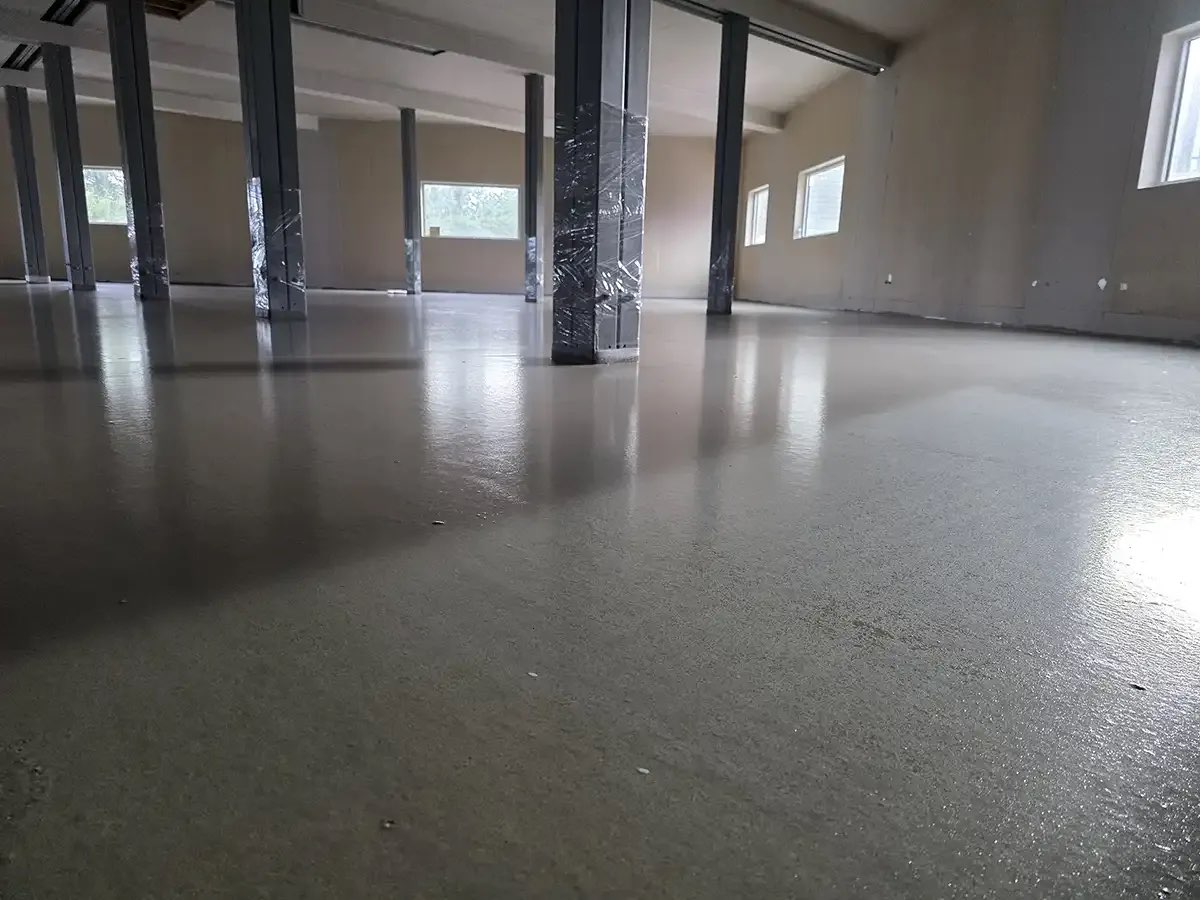
Pumped flowing screed self-levelling across a large open floor plate.
Scoping
## First, is it a screed you need?
Worth settling early, because it is the most common mis-tender we see. We deliver both, so there is no incentive here to talk you into either.
### A screed
A levelling layer laid over a base or a structural deck. It creates the finished level and the surface the floor covering sits on. It is not the structure. If the drawings show a structural deck with a topping over it, you want a screed.
### An in-situ concrete floor
The structural slab itself, usually power floated to a hard, durable finish that is walked and driven on directly. If the drawings show the slab as the finished floor, see [concrete flooring](https://www.trentcs.com/concrete-flooring).
Systems
## Which screed system
### [Service Flowing screed, also called liquid screed Pumped, self-levelling, fast over large areas and the best method for underfloor heating because it fully encases the pipes. The default choice for large floor plates and occupied buildings. Read more](https://www.trentcs.com/screeds/flowing-screed)
### [Service Self-compacting screed Consolidates under its own weight, so there is no power floating and therefore no late or night working on site. Where the site will not permit finishing crews on the deck in the evening, this is the system that solves it. Read more](https://www.trentcs.com/screeds/self-compacting)
### [Service Screeds on precast planks Not a different material so much as a different problem. Precast and hollowcore decks on upper floors need the screed getting up there, which is a placing question before it is a screed question. Read more](https://www.trentcs.com/screeds/precast-plank)
System
### Traditional sand & cement
Still right for small, chopped-up or heavily detailed areas, for steep falls, and where a bonded screed at depth is specified. Slower and more labour-intensive over a large floor plate, which is why the pumped systems have taken most of the market.
Scoping
## The decision you are actually making
Five questions set the price and the programme. Answer them at tender and the job runs clean.
- **Which binder, and what is going on top?** Flowing screeds are broadly calcium sulphate based (anhydrite) or cementitious. Calcium sulphate flows well and is widely used, but it is moisture-sensitive and usually needs its surface laitance removing before adhered floor coverings. Cementitious avoids both and costs more. The finishes schedule should decide this.
- **Bonded, unbonded or floating?** Each has a different minimum depth and a different tolerance for a base that is out of level. Floating over insulation is the normal arrangement with underfloor heating.
- **What surface regularity class is specified?** The BS 8204 class changes the method and the price.
- **What is the drying programme?** Moisture-sensitive floor coverings drive the drying, and drying often drives the fit-out. This is the item most likely to bite a programme, and it should be designed rather than assumed.
- **Can the deck be reached?** On upper floors this is the whole job. If plant has to be craned up, the price and the programme change. If it does not, they do not.
Standards
## Tolerances and standards
Screed surface regularity is normally specified to BS 8204, measured as the maximum deviation under a 2m straightedge:
| Class | Maximum deviation | Typically used for |
| --- | --- | --- |
| SR1 | 3mm | High specification floors and demanding floor finishes |
| SR2 | 5mm | The general default for most commercial projects |
| SR3 | 10mm | Utility areas and floors taking a thick applied finish |
Screed materials are separately classified by binder type under BS EN 13813, which is what the manufacturer's declaration of performance refers to.
Where the work is an in-situ concrete floor rather than a screed, flatness is specified to TR34 as an FM classification instead. Different standard, different test, different survey.
Capability
## Plant and crews, self-delivered
Our own operatives, our own pumps, our own placing booms, start to finish.
Placing is the differentiator. We run our own concrete line pumps and track-mounted placing booms, rare kit in this country. They deliver screed across upper decks and into restricted spaces without craning plant up, which is why we can price work that other screeding subcontractors decline.
Because the plant is ours, the placing method is planned as part of the works rather than bolted on afterwards. Pump positions, hose runs, boom set-up, outrigger loadings and wash-out are all agreed before we mobilise. More on the company and the plant at [about Trent](https://www.trentcs.com/about).
Programme
## Output, programme and constraints
Pumped screed covers ground fast. The limit is almost never the screed, it is the access, the number of pump set-ups the building allows, the delivery route, and how much of the deck is genuinely ready. We programme from the ready date backwards.
- **Live and occupied buildings.** Hospitals, schools and operational facilities where the working day belongs to someone else. Clean, contained, pumped methods and phasing agreed around the operation.
- **No late working.** Where evening and night shifts are not permitted, self-compacting systems remove the power floating step that forces them.
- **Upper decks.** Placing booms reach floors at height without craning plant up.
- **Restricted access.** Tight gates, low headroom, live yards, limited set-up space. Reach is planned, not improvised.
- **Phased programmes.** Screed delivered in sections around other trades, with day joints designed to suit the phasing.
- **Honesty about readiness.** If the insulation, the underfloor heating, the edge detailing or the deck preparation will not be complete when the programme says, we say so at tender rather than on the day the pump is booked.
Proof
## Evidence and documentation
- Surface regularity survey against the specified BS 8204 class
- Delivery tickets and batch records
- Pour records: area, depth, date and conditions
- Manufacturer's declaration of performance for the system installed
- Moisture readings before floor coverings where we are asked to take them
- RAMS issued and agreed before mobilisation
- Sign-off pack at handover
Constructionline Gold registered. ISO 9001 certified. ACIFC member. Cyber Essentials Plus, Avetta and SSIP accredited. Member of the Nuclear Industry Association. Tier 1 main contractors we deliver for include VINCI, McLaren, Costain, Kier, Interclass, Tomlinson, SMD, Actavo, Tarmac and Veolia.
If you tender screed projects regularly, [how we work with main contractors](https://www.trentcs.com/main-contractors) sets out what we commit to.
FAQs
## Common questions
Which screed system is right for my project?
It depends on the deck, the finish and the programme. We match flowing, self-compacting or traditional screed to suit and advise you. Send the drawings and the finishes schedule and you will get a straight recommendation. We install cementitious flowing screeds including Cemfloor and Longfloor, calcium sulphate screeds, self-compacting, proprietary bagged and sand and cement screeds.
What is the difference between flowing screed and liquid screed?
None. Flowing screed, liquid screed, flow screed and self-levelling screed all describe a pumped screed that consolidates under its own weight.
Can you reach upper decks?
Yes. Our line pumps reach around 100m vertically and our track-mounted placing booms around 16m, so there's no craning plant up.
Can screed be laid in occupied buildings?
Yes. Pumped systems are fast and low-disruption, which suits live environments with careful phasing. It is a large part of what we do.
Can you avoid night working?
Usually. Self-compacting systems remove the power floating step, which is normally what forces late shifts on a screeded deck.
Do you screed to falls?
Yes. Roof and plant screeds are laid to the specified gradients.
Related
[Service**Flowing screed***→*](https://www.trentcs.com/screeds/flowing-screed)[Service**Self-compacting screed***→*](https://www.trentcs.com/screeds/self-compacting)[Service**Precast plank screed***→*](https://www.trentcs.com/screeds/precast-plank)
Guides and case studies
[Guide**Precast plank screeds: programme and follow-on trades***→*](https://www.trentcs.com/knowledge/precast-plank-screeds-programme-and-follow-on-trades)[Guide**Screed on beam and block and hollowcore decks***→*](https://www.trentcs.com/knowledge/screed-on-beam-and-block-and-hollowcore-decks)[Guide**Floor screeds for schools: making the holiday window work***→*](https://www.trentcs.com/knowledge/floor-screeds-for-schools-making-the-holiday-window-work)
## Got a flooring or screed *project coming up?*
Send us the drawings and the specification, and we'll tell you straight whether we can deliver it, and how.
[Discuss your project](https://www.trentcs.com/contact)
Specialist concrete flooring and screed subcontractor. Our own teams and plant, finished to specification. Nationwide.
 Certificate No. 292582018
Services
- [Concrete flooring](https://www.trentcs.com/concrete-flooring)
- [Screeds](https://www.trentcs.com/screeds)
- [Concrete pumping](https://www.trentcs.com/concrete-pumping)
- [Projects](https://www.trentcs.com/projects)
Company
- [About](https://www.trentcs.com/about)
- [Sectors](https://www.trentcs.com/sectors)
- [Main contractors](https://www.trentcs.com/main-contractors)
- [Knowledge](https://www.trentcs.com/knowledge)
- [Contact](https://www.trentcs.com/contact)
Contact
- **Head office**
Trent House, Bridge Park,
Wetmore Road, Burton on Trent,
DE14 1PW
- **Aldermaston**
Suite 1 Calleva Business Centre,
Calleva Park, Aldermaston,
Berkshire, RG7 8UA
- [01283 480110](tel:01283480110)
- [info@trentcs.com](mailto:info@trentcs.com)
© 2026 Trent Construction Services Ltd. All rights reserved. [Privacy](https://www.trentcs.com/legal#privacy) · [Cookies](https://www.trentcs.com/legal#cookies) · [Terms](https://www.trentcs.com/legal#terms) ·
Cookie settings
Laid to last.
```json
{
"@context" : "https://schema.org",
"@type" : "FAQPage",
"mainEntity" : [ {
"@type" : "Question",
"acceptedAnswer" : {
"@type" : "Answer",
"text" : "It depends on the deck, the finish and the programme. We match flowing, self-compacting or traditional screed to suit and advise you. Send the drawings and the finishes schedule and you will get a straight recommendation. We install cementitious flowing screeds including Cemfloor and Longfloor, calcium sulphate screeds, self-compacting, proprietary bagged and sand and cement screeds."
},
"name" : "Which screed system is right for my project?"
}, {
"@type" : "Question",
"acceptedAnswer" : {
"@type" : "Answer",
"text" : "None. Flowing screed, liquid screed, flow screed and self-levelling screed all describe a pumped screed that consolidates under its own weight."
},
"name" : "What is the difference between flowing screed and liquid screed?"
}, {
"@type" : "Question",
"acceptedAnswer" : {
"@type" : "Answer",
"text" : "Yes. Our line pumps reach around 100m vertically and our track-mounted placing booms around 16m, so there's no craning plant up."
},
"name" : "Can you reach upper decks?"
}, {
"@type" : "Question",
"acceptedAnswer" : {
"@type" : "Answer",
"text" : "Yes. Pumped systems are fast and low-disruption, which suits live environments with careful phasing. It is a large part of what we do."
},
"name" : "Can screed be laid in occupied buildings?"
}, {
"@type" : "Question",
"acceptedAnswer" : {
"@type" : "Answer",
"text" : "Usually. Self-compacting systems remove the power floating step, which is normally what forces late shifts on a screeded deck."
},
"name" : "Can you avoid night working?"
}, {
"@type" : "Question",
"acceptedAnswer" : {
"@type" : "Answer",
"text" : "Yes. Roof and plant screeds are laid to the specified gradients."
},
"name" : "Do you screed to falls?"
} ]
}
```
```json
{
"@context" : "https://schema.org",
"@type" : "BreadcrumbList",
"itemListElement" : [ {
"@type" : "ListItem",
"item" : "https://www.trentcs.com/",
"name" : "Home",
"position" : 1
}, {
"@type" : "ListItem",
"name" : "Screeds",
"position" : 2
} ]
}
```
```json
{
"@context" : "https://schema.org",
"@type" : "Service",
"areaServed" : {
"@type" : "Country",
"name" : "United Kingdom"
},
"audience" : {
"@type" : "BusinessAudience",
"audienceType" : "Main contractors and clients on commercial construction projects"
},
"description" : "Trent Construction Services installs liquid, flowing, self-compacting and traditional screeds for main contractors on commercial projects across the UK, including screeds and structural toppings on precast concrete planks, placed with our own booms where access is tight and time is short.",
"name" : "Floor screeds",
"provider" : {
"@id" : "https://www.trentcs.com/#organization"
},
"serviceType" : "Floor screeds",
"url" : "https://www.trentcs.com/screeds"
}
```
```json
{
"@context" : "https://schema.org",
"@id" : "https://www.trentcs.com/#organization",
"@type" : "Organization",
"address" : {
"@type" : "PostalAddress",
"addressCountry" : "GB",
"addressLocality" : "Burton on Trent",
"addressRegion" : "Staffordshire",
"postalCode" : "DE14 1PW",
"streetAddress" : "Trent House, Bridge Park, Wetmore Road"
},
"areaServed" : {
"@type" : "Country",
"name" : "United Kingdom"
},
"audience" : {
"@type" : "BusinessAudience",
"audienceType" : "Main contractors and clients on commercial construction projects"
},
"contactPoint" : {
"@type" : "ContactPoint",
"areaServed" : "GB",
"availableLanguage" : "English",
"contactType" : "sales",
"email" : "info@trentcs.com",
"telephone" : "+441283480110"
},
"description" : "Specialist concrete flooring and screed subcontractor for main contractors and clients on commercial projects across the UK, including live, restricted-access and constrained sites. No domestic or self-build work.",
"email" : "info@trentcs.com",
"foundingDate" : "2012-03-13",
"hasCredential" : [ {
"@type" : "EducationalOccupationalCredential",
"credentialCategory" : "certification",
"name" : "Constructionline Gold"
}, {
"@type" : "EducationalOccupationalCredential",
"credentialCategory" : "certification",
"name" : "Avetta accredited"
}, {
"@type" : "EducationalOccupationalCredential",
"credentialCategory" : "certification",
"name" : "SSIP member"
}, {
"@type" : "EducationalOccupationalCredential",
"credentialCategory" : "certification",
"name" : "ISO 9001"
}, {
"@type" : "EducationalOccupationalCredential",
"credentialCategory" : "certification",
"name" : "Cyber Essentials Plus"
} ],
"identifier" : {
"@type" : "PropertyValue",
"propertyID" : "Companies House company number",
"value" : "07988958"
},
"knowsAbout" : [ "Power floated concrete floors", "Laser screed concrete flooring", "Concrete hardstanding", "Flowing screed", "Self-compacting screed", "Screeds on precast planks", "Concrete pumping and placing booms" ],
"legalName" : "Trent Construction Services Ltd",
"location" : [ {
"@type" : "Place",
"address" : {
"@type" : "PostalAddress",
"addressCountry" : "GB",
"addressLocality" : "Burton on Trent",
"addressRegion" : "Staffordshire",
"postalCode" : "DE14 1PW",
"streetAddress" : "Trent House, Bridge Park, Wetmore Road"
},
"name" : "Head office"
}, {
"@type" : "Place",
"address" : {
"@type" : "PostalAddress",
"addressCountry" : "GB",
"addressLocality" : "Aldermaston",
"addressRegion" : "Berkshire",
"postalCode" : "RG7 8UA",
"streetAddress" : "Suite 1 Calleva Business Centre, Calleva Park"
},
"name" : "Aldermaston office"
} ],
"memberOf" : [ {
"@type" : "Organization",
"alternateName" : "ACIFC",
"name" : "Association of Concrete Industrial Flooring Contractors"
}, {
"@type" : "Organization",
"name" : "Nuclear Industry Association"
} ],
"name" : "Trent Construction Services",
"sameAs" : [ "https://find-and-update.company-information.service.gov.uk/company/07988958" ],
"slogan" : "Laid to last.",
"telephone" : "+441283480110",
"url" : "https://www.trentcs.com/"
}
```
```json
{
"@context" : "https://schema.org",
"@id" : "https://www.trentcs.com/#website",
"@type" : "WebSite",
"description" : "Specialist concrete flooring and screed subcontractor working on live, restricted-access and constrained sites nationwide.",
"inLanguage" : "en-GB",
"name" : "Trent Construction Services",
"publisher" : {
"@id" : "https://www.trentcs.com/#organization"
},
"url" : "https://www.trentcs.com/"
}
```