Home  /  Concrete flooring  /  Large pour & laserscreed

In-situ concrete flooring

Large pour & laserscreed.

High-output laser screed and large pour floors for fast, flat, large-area slabs where programme and surface regularity both matter.

The work

Large areas, laid fast and flat

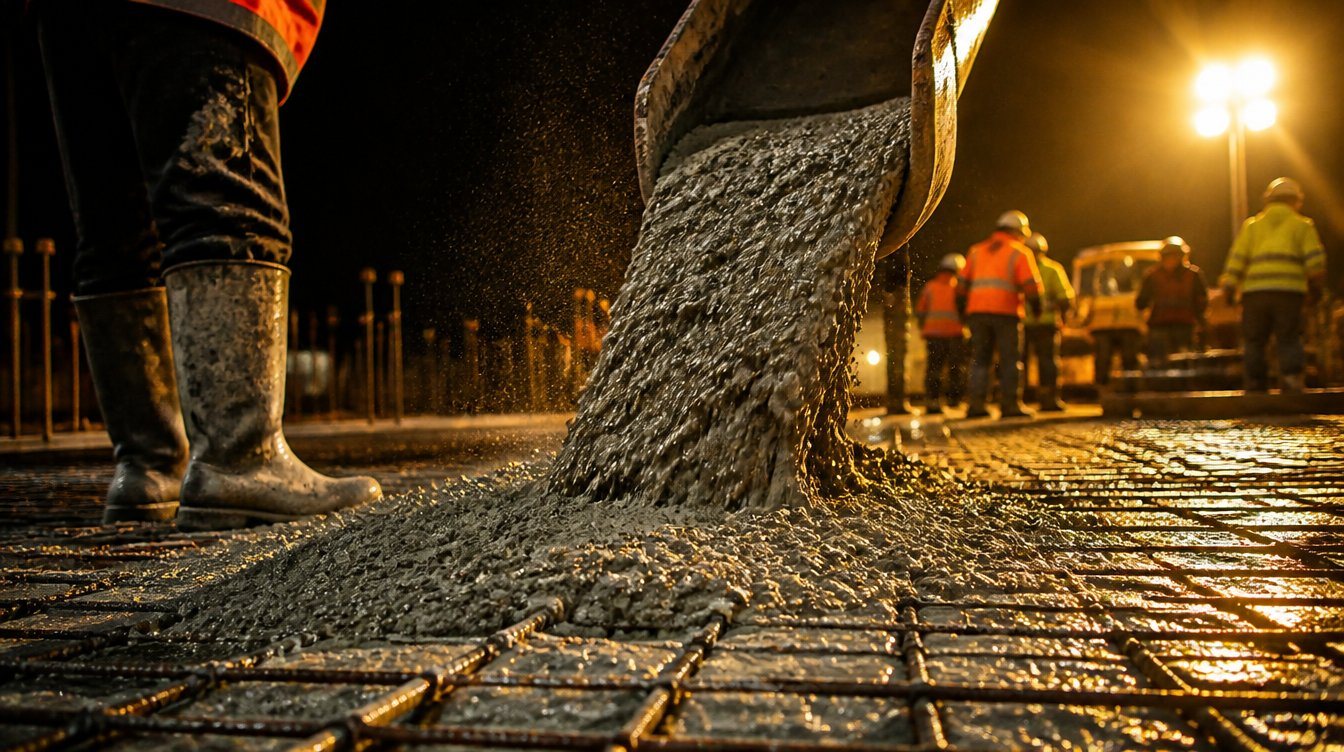
Laser screed plant places and levels concrete in a single controlled pass. A laser reference sets the level, the machine strikes off and vibrates to it, and the slab comes out flat over a much wider pour than hand methods can hold. It suits warehouses, distribution centres and any large-area slab on a tight programme.

We plan the pour sequence, joint layout and logistics so the area goes down efficiently without compromising the finish. Then the surface is power floated behind the laser screed to give the dense, hard-wearing finish an industrial floor needs.

Two things come out of it together: area and tolerance. That is the whole point. Hand methods can give you one or the other over a big floor plate, rarely both, and never quickly.

Note on the term: you will see it written as laser screed, laserscreed and Laser Screed, and Somero's own machine name is the S-22EZ Laser Screed. They all mean the same plant and the same method.

When large pour is the right approach

Laser screed placing earns its cost on area. Below a certain floor plate the set-up, the working platform and the plant movements cost more than they save, and a conventional pour is the better answer. Compare the options at concrete flooring. See power floated floors.

Above that, the calculation flips fast. A large distribution floor placed conventionally takes weeks of narrow bays, day joints and finishing crews. Placed by laser screed, it takes a fraction of that in far wider pours, with fewer joints and a more consistent surface.

Programme is usually what decides it. If the building has to be handed to the racking installer or the fit-out on a fixed date, high-output placing is often the only method that gets there.

The decision you are actually making

How big is the pour, and how flat does it have to be? Area and grade together set the plant, the crew and the number of days. A tight grade over a large area is the most demanding combination on this page.

How many joints can the floor carry? Wider pours mean fewer joints. Joints are where floors fail and where maintenance cost lives, so fewer is usually better, but joint spacing has to work with the slab design and the reinforcement.

Is the sub-base ready and to tolerance? Laser screed plant runs on the prepared base and needs it flat and firm. A loose or out-of-tolerance sub-base is paid for in concrete volume, in a regulating operation, or in a machine that cannot work properly.

Is the building watertight and is there a clear run? Laser screed placing wants continuous, uninterrupted pours across open floor. Columns, pits, drainage runs and half-finished steelwork all slow it down and should be priced honestly rather than ignored.

How fast can concrete arrive? On a large pour the batching plant and the delivery route become the constraint. There is no point resourcing for high output if the supply cannot feed it.

Flatness grades, named

Large industrial floors in the UK are normally specified to the Concrete Society's Technical Report 34, currently in its 4th edition. TR34 sets free movement classifications FM1 to FM4 and controls two properties separately.

Property E controls levelness, measured between fixed points 3m apart on a grid.

Property F controls flatness, the change in elevational difference between two consecutive measurements each over 300mm.

Compliance is assessed on the 95th percentile value:

ClassProperty E (levelness)Property F (flatness)Typically specified for
FM14.5mm1.8mmReach trucks above 13m without side-shift
FM26.5mm2.0mmReach trucks 8m to 13m without side-shift
FM38.0mm2.2mmReach trucks up to 8m, retail floors with directly applied finishes
FM410.0mm2.4mmRetail floors with applied screeds, workshops up to 4m lift height

Laser screed placing is the normal route to FM2 across a large floor plate, because holding that tolerance over that area by hand is impractical. Where trucks run fixed routes in very narrow aisles, a defined movement specification applies instead and the floor is surveyed differently.

Plant and crews, self-delivered

We run a Somero S22EZ laser screed, our own concrete line pumps, our own power floats, and two track-mounted placing booms which are two of only three in the country. All of it operated by our own people.

That matters on a large pour more than anywhere else. High-output placing only works if the placing, the levelling and the finishing are one operation run by one team. Split it across subcontractors and the day falls apart at the first hold-up, because nobody owns the sequence.

Our placing booms also mean a large pour is not limited to ground-bearing slabs with easy access. Upper decks and restricted spaces are reachable without craning plant up, which is why we get asked to price large pours that other subcontractors cannot deliver. We take on the floors others won't.

Output and programme

High output is the reason to choose this method, so it deserves a straight answer rather than an adjective.

Daily output on a laser screed pour is governed by the concrete supply, the width of the pour the building allows, the flatness grade, and how much uninterrupted floor there is to run across. A clear, open, watertight shed with a good delivery route produces a very different figure from a phased pour around live operations.

We plan the pour sequence and joint layout first, then resource to it, then give you the duration. If the programme in the tender documents does not work, you hear it at tender.

Constraints handled

Large pours are usually thought of as an empty-shed operation. Ours are not always.

  • Phased programmes. On constrained or live sites we phase large pours around access windows and other trades, with the joint layout designed around the phasing rather than fighting it.
  • Restricted access. Where ready-mix cannot reach the pour face, our line pumps and placing booms place it. Reach is designed into the works. See concrete pumping.
  • Upper decks and suspended slabs. Large-area placing at height, without craning plant up.
  • Live operations. Where the building is working around us, the sequence, the delivery route and the wash-out arrangements are agreed before we mobilise.
  • Weather. Large open pours are exposed until the roof and cladding are on. Wind and rain change the finishing window, and we programme for it rather than hoping.

Evidence and documentation

  • Flatness survey against the specified TR34 classification
  • Concrete cube results for compressive strength
  • Pour records: date, bay, area, volume, mix and conditions
  • Joint layout as constructed
  • Curing method and durations
  • RAMS issued and agreed before mobilisation
  • Sign-off pack at handover

Constructionline Gold registered. Avetta and SSIP accredited. Member of the Nuclear Industry Association.

Where large pour fits

Distribution and big-box

Large distribution floors need both speed and flatness. Laser screed delivers the area and the tolerance together, which is why it is the standard method for big-box warehousing. See warehouse and distribution centre floors.

Data centres

Data halls demand tight tolerances over large floor plates with full documentation, and the survey evidence matters as much as the floor. See data centre flooring.

Phased and live sites

Where the building keeps working, we phase large pours around access windows and other trades rather than waiting for an empty building that never arrives.

FAQs

Common questions

How large an area can you pour in a day?
Laser screed gives high output, and we plan the pour sequence and joints to cover large areas quickly without compromising flatness. The figure depends on concrete supply, pour width, the flatness grade and how open the floor is.
Is laser screed flatter than hand finishing?
Over a large area, yes. Laser-guided levelling holds tighter surface regularity across a big floor plate than manual methods can, and it does it in wider pours with fewer joints.
What flatness grade can you achieve?
We work to the TR34 free movement classification the specification names, then survey and record the result.
Do you power float after the laser screed?
Yes. The laser screed places and levels, then the surface is power floated to give the dense, hard-wearing industrial finish.
Can you work to a tight programme?
Yes. High output is the point, and we phase pours around access and other trades. We will also tell you at tender if the programme as written does not work.
What do you need from the sub-base?
Flat, firm and to tolerance. The machine runs on it, and a loose or uneven base costs concrete volume or a regulating operation. Get the base survey done before the floor is priced.
Can you do a large pour on an upper deck?
Yes. Our track-mounted placing booms deliver concrete at height without craning plant up.
How many joints will the floor have?
Fewer than a conventionally placed floor, because the pours are wider. Exact spacing comes out of the slab design, the reinforcement and the loadings.
Is there a minimum area that makes this worthwhile?
There is a point below which set-up and plant movement cost more than they save, and a conventional power floated pour is better.
Who surveys the finished floor?
Flatness is surveyed against the specified classification and the results are issued to you.

Got a flooring or screed project coming up?

Send us the drawings and the specification, and we'll tell you straight whether we can deliver it, and how.

Discuss your project