---
title: Energy from Waste & Transfer Station Floors | Repairs
description: Heavy-duty floors, hardstandings and floor refurbishment for energy from waste, waste transfer and recycling facilities. Shutdown windows. Nationwide.
image: https://www.trentcs.com/hubfs/OG%20images/og-sectors-waste-energy.png
---
- Services
[Concrete flooring](https://www.trentcs.com/concrete-flooring)
- [Power floated floors](https://www.trentcs.com/concrete-flooring/power-floated)
- [Hardstandings](https://www.trentcs.com/concrete-flooring/hardstanding)
- [Large pours](https://www.trentcs.com/concrete-flooring/large-pour)
[Screeds](https://www.trentcs.com/screeds)
- [Flowing screed](https://www.trentcs.com/screeds/flowing-screed)
- [Self-compacting](https://www.trentcs.com/screeds/self-compacting)
- [Precast plank](https://www.trentcs.com/screeds/precast-plank)
- [Concrete pumping](https://www.trentcs.com/concrete-pumping)
- Sectors
- [All sectors](https://www.trentcs.com/sectors)
- [Healthcare](https://www.trentcs.com/sectors/healthcare)
- [Data centres](https://www.trentcs.com/sectors/data-centres)
- [Industrial & logistics](https://www.trentcs.com/sectors/industrial-logistics)
- [Education](https://www.trentcs.com/sectors/education)
- [Waste & energy](https://www.trentcs.com/sectors/waste-energy)
- [Secure & regulated](https://www.trentcs.com/sectors/secure-regulated)
- [Projects](https://www.trentcs.com/projects)
- [Knowledge](https://www.trentcs.com/knowledge)
- [About](https://www.trentcs.com/about)
- [Main contractors](https://www.trentcs.com/main-contractors)
- [01283 480110](tel:01283480110)
- [Discuss your project](https://www.trentcs.com/contact)
[01283 480110](tel:01283480110)
☰
- Services
[Concrete flooring](https://www.trentcs.com/concrete-flooring)
- [Power floated floors](https://www.trentcs.com/concrete-flooring/power-floated)
- [Hardstandings](https://www.trentcs.com/concrete-flooring/hardstanding)
- [Large pours](https://www.trentcs.com/concrete-flooring/large-pour)
[Screeds](https://www.trentcs.com/screeds)
- [Flowing screed](https://www.trentcs.com/screeds/flowing-screed)
- [Self-compacting](https://www.trentcs.com/screeds/self-compacting)
- [Precast plank](https://www.trentcs.com/screeds/precast-plank)
- [Concrete pumping](https://www.trentcs.com/concrete-pumping)
- Sectors
- [All sectors](https://www.trentcs.com/sectors)
- [Healthcare](https://www.trentcs.com/sectors/healthcare)
- [Data centres](https://www.trentcs.com/sectors/data-centres)
- [Industrial & logistics](https://www.trentcs.com/sectors/industrial-logistics)
- [Education](https://www.trentcs.com/sectors/education)
- [Waste & energy](https://www.trentcs.com/sectors/waste-energy)
- [Secure & regulated](https://www.trentcs.com/sectors/secure-regulated)
- [Projects](https://www.trentcs.com/projects)
- [Knowledge](https://www.trentcs.com/knowledge)
- [About](https://www.trentcs.com/about)
- [Main contractors](https://www.trentcs.com/main-contractors)
- [Call 01283 480110](tel:01283480110)
- [Discuss your project](https://www.trentcs.com/contact)
[Home](https://www.trentcs.com/) / [Sectors](https://www.trentcs.com/sectors) / Waste & energy
Sector
# Floors and refurbishment for *energy from waste.*
Trent Construction Services delivers heavy-duty floors, hardstandings and floor refurbishment for main contractors and clients at energy from waste, waste transfer and recycling facilities across the UK, engineered for exceptional loads and abrasion.
The work
## Surfaces built for the toughest duty
Waste and energy facilities put extreme demands on floors and hardstandings, with constant heavy traffic, point loads and abrasion, often on live operational sites.
We engineer the build-up and finish for the duty, and phase works around continuous operations. We delivered heavy-duty work for [Veolia at Southampton](https://www.trentcs.com/knowledge/heavy-duty-flooring-for-veolia-southampton).
Proof, not promises. This is a sector where a floor that looks fine at handover can be gone in two years, so the specification has to be right before the first pour.
On site
## Built around your operation, *not against it.*
We plan the method, phasing and plant so work continues around us and the floor goes down right first time.
The problem
## Abrasion is the failure mode, and it is measurable
Most sectors worry about cracking. This one worries about the floor wearing away. Waste is tipped directly onto concrete from collection vehicles and then pushed and scraped by loading shovels, and the Concrete Society has recorded wear rates in excess of 25mm in a single year on some domestic waste transfer floors. Three levers control it: the concrete itself, the surface, and the joints.
- **Wear is not even.** It concentrates in the tipping area, in the wheel paths and in the pushing zones where the shovel works against the floor. A floor designed to an average duty fails in those places first, so the specification has to follow the operation rather than the floor plate.
- **The concrete.** A high-strength, low-permeability mix with a hard, well-graded aggregate resists wear better than a general slab.
- **The surface.** The finish and curing decide how dense the top few millimetres are, which is where abrasion actually happens.
- **The joints.** Arrised or unarmoured joints in a shovel run are where the damage starts and spreads.
Refurbishment
## Floor refurbishment inside a shutdown window
Replacing a worn tipping or transfer floor without the plant losing more days than the shutdown allows.
A tipping floor in an energy from waste or waste transfer facility does not wear out gently. Loading shovels scrape it continuously, and a floor that has lost its surface will keep losing it faster, until the reinforcement is exposed and the buckets start catching. At that point the floor is not a maintenance item, it is a shutdown.
Refurbishment work of this kind is bought on one thing: the date the plant runs again. The window is fixed, usually short, and the penalty for overrunning is measured in tonnes not processed. That drives the whole method. Planing and preparation are sized to the crew and plant available rather than the other way round. High early strength concrete is specified so the floor takes traffic within the window rather than after it. Sequencing is agreed so demolition, preparation and placing overlap wherever the area allows.
For facilities running heavy loading shovels over the same lines day after day, we also install an embedded rail system that takes the wear where the wear actually happens, rather than asking the slab to survive it. We have delivered this approach around a dozen times.
We self-deliver this work: our own crews, our own pumps and placing booms, so the programme does not depend on a hire company. See [our projects](https://www.trentcs.com/projects).
Scoping
## The decision you are actually making
### What is the actual operation on that floor?
Tipping, pushing, storage, vehicle circulation and standing all wear differently. Zone the floor by duty and specify each zone for what happens on it.
### What plant works the floor?
Loading shovel size and how the operator uses the bucket against the slab is the single biggest wear factor, and it varies enormously between sites.
### New slab or overlay?
Existing facilities usually want a repair or an overlay rather than a new slab, and the two are completely different projects. An overlay depends entirely on the condition and preparation of what is underneath.
### How much of the facility can close, and for how long?
Waste facilities have contractual tonnage obligations. Closing a tipping hall is not a small ask, and the phasing usually drives the whole method.
### What about push walls and edges?
The slab-to-wall junction takes heavy impact. Detailing it properly is what stops the failure spreading in from the edges.
### Drainage and containment
Leachate, wash-down and surface water all have to go somewhere, and environmental permitting usually specifies where. Falls and containment are part of the design, not an afterthought.
Energy
## Energy from waste and biomass
Energy facilities share the abrasion problem, and add their own. Bunker floors and tipping halls see the same shovel and vehicle duty as a transfer station. Fuel handling and storage areas see abrasion plus, in biomass, a different chemical environment. Turbine halls, plant rooms and equipment bases need tight setting out to supplier drawings rather than heavy duty. External areas and hardstandings take continuous HGV movement.
One facility can therefore need three or four different floor specifications, and pricing it as a single rate is how projects go wrong.
Systems
## Systems we install for this sector
### [Service Concrete hardstanding External yards, tipping areas, service roads and lorry parks, engineered for HGV loads and laid to falls for drainage. Read more](https://www.trentcs.com/concrete-flooring/hardstanding)
### [Service Power floated floors Internal slabs where a dense, hard-wearing surface is the requirement. Read more](https://www.trentcs.com/concrete-flooring/power-floated)
### [Service Large pour & laser screed Where the area is big and the programme is short. Read more](https://www.trentcs.com/concrete-flooring/large-pour)
Service
### Plant & equipment bases
Set out and poured to tight tolerances against supplier drawings.
Capability
## Plant and crews, self-delivered
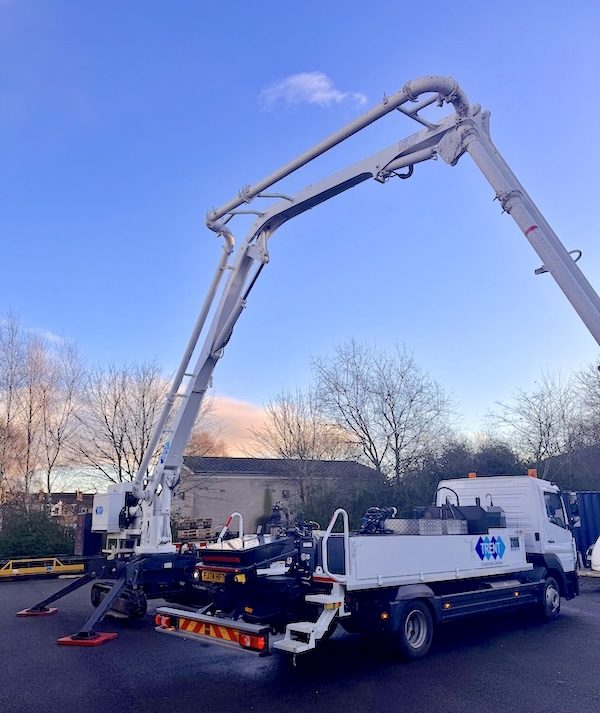
Our own operatives, our own power floats, our own concrete line pumps, and our own track-mounted placing booms, rare kit in this country.
Placing is usually the hard part on these sites. A live waste facility has vehicles moving constantly, limited standing space, and areas that cannot be reached by a ready-mix truck without shutting down a route the site needs. Our own pumps and booms put the concrete where it needs to go without closing the operation down around it. See [concrete pumping](https://www.trentcs.com/concrete-pumping).
Self-delivery also means the finish is ours. On a floor where the top few millimetres decide whether it lasts two years or twenty, the finishing and curing are not something to hand to somebody else.
Delivery
## Constraints handled
Live facilities, congested access and permit conditions are normal here. We plan for them at tender, not on the day.
- **Live operational facilities.** Waste sites have tonnage obligations and cannot simply stop. Works are phased, sections released and handed back, and the operation keeps running.
- **Restricted and congested access.** Constant vehicle movement, limited standing space, areas unreachable by ready-mix. Pumped and boom placed.
- **Aggressive environments.** Dust, odour, leachate and heavy plant. Method and welfare planned for the environment rather than for a clean site.
- **Environmental permitting.** Containment, drainage and wash-out arrangements agreed to the site's permit conditions before mobilisation.
- **Weather.** External work in a working yard, planned around wind, rain and cold rather than hoping for a good week.
- **Short shutdown windows.** Where a hall can only close for a fixed period, we programme backwards from the reopening date and say at tender if it does not work.
Proof
## Evidence and documentation
- Concrete cube results for compressive strength
- Levels and falls survey confirming drainage design
- Flatness survey where a grade is specified
- Pour records: date, bay, area, volume, mix and conditions
- Joint layout as constructed
- Curing method and durations, which matter more here than on almost any other floor
- RAMS issued and agreed before mobilisation, written to the site's permit and operational constraints
- Sign-off pack at handover
Constructionline Gold registered. ISO 9001 certified. ACIFC member. Cyber Essentials Plus, Avetta and SSIP accredited. Member of the Nuclear Industry Association. We have delivered for Veolia and Tarmac among others.
FAQs
## Common questions
Why do waste transfer floors wear out so quickly?
Tipping and shovel work is exceptionally abrasive. The Concrete Society has recorded wear rates above 25mm a year on some domestic waste transfer floors. It concentrates in tipping areas, wheel paths and pushing zones rather than spreading evenly.
How do you make a floor abrasion resistant?
Through the mix, the surface and the joints. A high-strength, low-permeability concrete with hard aggregate, a properly finished and cured surface, and joints detailed so shovel work does not start damage at the edges.
Can you overlay an existing worn floor rather than replace it?
It depends entirely on the condition and the preparation of what is underneath. An overlay and a new slab are different projects with different risks.
Can you work on a live operational facility?
Yes. We phase works around continuous operations, releasing and handing back sections so the site keeps running.
Do you do the external yards as well?
Yes. Hardstandings for tipping areas, service roads, lorry parks and circulation, laid to falls with drainage designed in.
Can you reach areas a ready-mix truck cannot?
Yes. Our own line pumps and track-mounted placing booms place concrete without closing down the routes the site needs.
Related
[Project**Veolia, Southampton***→*](https://www.trentcs.com/knowledge/heavy-duty-flooring-for-veolia-southampton)[Service**Concrete pumping***→*](https://www.trentcs.com/concrete-pumping)[Service**Power floated floors***→*](https://www.trentcs.com/concrete-flooring/power-floated)
Guides and case studies
[Guide**Concrete foundations for solar farms and battery storage***→*](https://www.trentcs.com/knowledge/concrete-foundations-solar-farms-battery-storage)
## Got a flooring or screed *project coming up?*
Send us the drawings and the specification, and we'll tell you straight whether we can deliver it, and how.
[Discuss your project](https://www.trentcs.com/contact)
Specialist concrete flooring and screed subcontractor. Our own teams and plant, finished to specification. Nationwide.
 Certificate No. 292582018
Services
- [Concrete flooring](https://www.trentcs.com/concrete-flooring)
- [Screeds](https://www.trentcs.com/screeds)
- [Concrete pumping](https://www.trentcs.com/concrete-pumping)
- [Projects](https://www.trentcs.com/projects)
Company
- [About](https://www.trentcs.com/about)
- [Sectors](https://www.trentcs.com/sectors)
- [Main contractors](https://www.trentcs.com/main-contractors)
- [Knowledge](https://www.trentcs.com/knowledge)
- [Contact](https://www.trentcs.com/contact)
Contact
- **Head office**
Trent House, Bridge Park,
Wetmore Road, Burton on Trent,
DE14 1PW
- **Aldermaston**
Suite 1 Calleva Business Centre,
Calleva Park, Aldermaston,
Berkshire, RG7 8UA
- [01283 480110](tel:01283480110)
- [info@trentcs.com](mailto:info@trentcs.com)
© 2026 Trent Construction Services Ltd. All rights reserved. [Privacy](https://www.trentcs.com/legal#privacy) · [Cookies](https://www.trentcs.com/legal#cookies) · [Terms](https://www.trentcs.com/legal#terms) ·
Cookie settings
Laid to last.
```json
{
"@context" : "https://schema.org",
"@type" : "FAQPage",
"mainEntity" : [ {
"@type" : "Question",
"acceptedAnswer" : {
"@type" : "Answer",
"text" : "Tipping and shovel work is exceptionally abrasive. The Concrete Society has recorded wear rates above 25mm a year on some domestic waste transfer floors. It concentrates in tipping areas, wheel paths and pushing zones rather than spreading evenly."
},
"name" : "Why do waste transfer floors wear out so quickly?"
}, {
"@type" : "Question",
"acceptedAnswer" : {
"@type" : "Answer",
"text" : "Through the mix, the surface and the joints. A high-strength, low-permeability concrete with hard aggregate, a properly finished and cured surface, and joints detailed so shovel work does not start damage at the edges."
},
"name" : "How do you make a floor abrasion resistant?"
}, {
"@type" : "Question",
"acceptedAnswer" : {
"@type" : "Answer",
"text" : "It depends entirely on the condition and the preparation of what is underneath. An overlay and a new slab are different projects with different risks."
},
"name" : "Can you overlay an existing worn floor rather than replace it?"
}, {
"@type" : "Question",
"acceptedAnswer" : {
"@type" : "Answer",
"text" : "Yes. We phase works around continuous operations, releasing and handing back sections so the site keeps running."
},
"name" : "Can you work on a live operational facility?"
}, {
"@type" : "Question",
"acceptedAnswer" : {
"@type" : "Answer",
"text" : "Yes. Hardstandings for tipping areas, service roads, lorry parks and circulation, laid to falls with drainage designed in."
},
"name" : "Do you do the external yards as well?"
}, {
"@type" : "Question",
"acceptedAnswer" : {
"@type" : "Answer",
"text" : "Yes. Our own line pumps and track-mounted placing booms place concrete without closing down the routes the site needs."
},
"name" : "Can you reach areas a ready-mix truck cannot?"
} ]
}
```
```json
{
"@context" : "https://schema.org",
"@type" : "BreadcrumbList",
"itemListElement" : [ {
"@type" : "ListItem",
"item" : "https://www.trentcs.com/",
"name" : "Home",
"position" : 1
}, {
"@type" : "ListItem",
"item" : "https://www.trentcs.com/sectors",
"name" : "Sectors",
"position" : 2
}, {
"@type" : "ListItem",
"name" : "Waste & energy",
"position" : 3
} ]
}
```
```json
{
"@context" : "https://schema.org",
"@id" : "https://www.trentcs.com/#organization",
"@type" : "Organization",
"address" : {
"@type" : "PostalAddress",
"addressCountry" : "GB",
"addressLocality" : "Burton on Trent",
"addressRegion" : "Staffordshire",
"postalCode" : "DE14 1PW",
"streetAddress" : "Trent House, Bridge Park, Wetmore Road"
},
"areaServed" : {
"@type" : "Country",
"name" : "United Kingdom"
},
"audience" : {
"@type" : "BusinessAudience",
"audienceType" : "Main contractors and clients on commercial construction projects"
},
"contactPoint" : {
"@type" : "ContactPoint",
"areaServed" : "GB",
"availableLanguage" : "English",
"contactType" : "sales",
"email" : "info@trentcs.com",
"telephone" : "+441283480110"
},
"description" : "Specialist concrete flooring and screed subcontractor for main contractors and clients on commercial projects across the UK, including live, restricted-access and constrained sites. No domestic or self-build work.",
"email" : "info@trentcs.com",
"foundingDate" : "2012-03-13",
"hasCredential" : [ {
"@type" : "EducationalOccupationalCredential",
"credentialCategory" : "certification",
"name" : "Constructionline Gold"
}, {
"@type" : "EducationalOccupationalCredential",
"credentialCategory" : "certification",
"name" : "Avetta accredited"
}, {
"@type" : "EducationalOccupationalCredential",
"credentialCategory" : "certification",
"name" : "SSIP member"
}, {
"@type" : "EducationalOccupationalCredential",
"credentialCategory" : "certification",
"name" : "ISO 9001"
}, {
"@type" : "EducationalOccupationalCredential",
"credentialCategory" : "certification",
"name" : "Cyber Essentials Plus"
} ],
"identifier" : {
"@type" : "PropertyValue",
"propertyID" : "Companies House company number",
"value" : "07988958"
},
"knowsAbout" : [ "Power floated concrete floors", "Laser screed concrete flooring", "Concrete hardstanding", "Flowing screed", "Self-compacting screed", "Screeds on precast planks", "Concrete pumping and placing booms" ],
"legalName" : "Trent Construction Services Ltd",
"location" : [ {
"@type" : "Place",
"address" : {
"@type" : "PostalAddress",
"addressCountry" : "GB",
"addressLocality" : "Burton on Trent",
"addressRegion" : "Staffordshire",
"postalCode" : "DE14 1PW",
"streetAddress" : "Trent House, Bridge Park, Wetmore Road"
},
"name" : "Head office"
}, {
"@type" : "Place",
"address" : {
"@type" : "PostalAddress",
"addressCountry" : "GB",
"addressLocality" : "Aldermaston",
"addressRegion" : "Berkshire",
"postalCode" : "RG7 8UA",
"streetAddress" : "Suite 1 Calleva Business Centre, Calleva Park"
},
"name" : "Aldermaston office"
} ],
"memberOf" : [ {
"@type" : "Organization",
"alternateName" : "ACIFC",
"name" : "Association of Concrete Industrial Flooring Contractors"
}, {
"@type" : "Organization",
"name" : "Nuclear Industry Association"
} ],
"name" : "Trent Construction Services",
"sameAs" : [ "https://find-and-update.company-information.service.gov.uk/company/07988958" ],
"slogan" : "Laid to last.",
"telephone" : "+441283480110",
"url" : "https://www.trentcs.com/"
}
```
```json
{
"@context" : "https://schema.org",
"@id" : "https://www.trentcs.com/#website",
"@type" : "WebSite",
"description" : "Specialist concrete flooring and screed subcontractor working on live, restricted-access and constrained sites nationwide.",
"inLanguage" : "en-GB",
"name" : "Trent Construction Services",
"publisher" : {
"@id" : "https://www.trentcs.com/#organization"
},
"url" : "https://www.trentcs.com/"
}
```